 Better Homes
Home renovation
Home renovation cost in London: the complete 2026 price guide
London-focused 2026 guide to full home renovation costs, hidden fees, room-by-room budgets, realistic timelines and renovate-vs-move economics.
Home Renovation Cost London 2026: The Complete Price Guide
A full home renovation in London costs between £800 and £3,500 per square metre in 2026, depending on specification level and property condition. For a typical 3-bedroom house of 110 square metres, that means an indicative budget of £88,000 to £385,000. Mid-range renovations - including new kitchen, bathrooms, full rewiring, replumbing, plastering, and redecorating throughout - typically fall between £1,200 and £1,800 per square metre, putting the realistic budget for most London homeowners at £132,000 to £198,000. London carries a 25 to 40 percent premium over national averages due to higher labour rates, restricted site access, parking and scaffold permits, and stricter borough planning requirements. Better Homes manages construction alongside independently appointed architects. As an initial planning allowance, budget a 10 to 15 percent contingency on top of any quoted price to cover hidden costs such as party wall agreements, asbestos removal, and unforeseen structural issues common in Victorian and Edwardian properties.
Use this guide to shape your initial renovation budget. The ranges and worked examples are illustrative planning allowances; your itemised quotation will reflect your home, measured floor area, agreed scope and specification. Allow for exclusions and contingency, and check whether VAT is included in each figure. Examples marked VAT-inclusive already include it.
Key Takeaways
1. London renovation costs range from £800 to £3,500+ per square metre - a light cosmetic refresh starts at £800/m² while a premium gut renovation with bespoke finishes can exceed £3,500/m².
2. A mid-range 3-bed renovation typically costs £132,000 to £198,000 - this includes a new kitchen, bathrooms, rewiring, replumbing, central heating, plastering, and full redecoration.
3. Kitchens and bathrooms consume 30 to 40 percent of most budgets - a London kitchen renovation runs £18,000 to £60,000 and bathrooms cost £8,000 to £25,000 depending on specification.
4. Hidden costs add £15,000 to £45,000+ - party wall agreements, building regulations, skip hire, parking permits, and VAT are frequently underbudgeted by first-time renovators.
5. Compare the full costs of renovating and moving — taxes, fees, finance and accommodation can change the decision. The worked moving example below separates transaction costs from redecoration.
6. Victorian and Edwardian homes cost 15 to 20 percent more to renovate - structural surprises, damp treatment, and period feature restoration drive costs above modern property equivalents.
7. Value uplift is not the same as profit — compare the estimated uplift with the full project spend and other costs. No percentage uplift is guaranteed.
What This Guide Covers
If you are a London homeowner considering a full renovation, the first question on your mind is almost certainly the same one we hear every week: how much is this actually going to cost me? It is a fair question - and one that is surprisingly difficult to answer without understanding the specific variables that apply to your property, your borough, and your ambitions for the finished home.
The truth is that home renovation costs in London vary enormously. A cosmetic home refurbishment of a modern flat might come in under £100,000, while a full gut renovation of a Victorian terrace in Hackney or Islington with structural work, a new kitchen, two new bathrooms, and a complete systems overhaul can easily exceed £200,000. What makes a home renovation in London particularly challenging to budget for is the capital's unique combination of period housing stock, complex planning rules, conservation area restrictions, premium labour rates, and logistical headaches that simply do not exist in other parts of the UK.
This guide draws on Better Homes' experience managing full design-and-build renovations across Central, East, and North London - combined with current 2026 market data from RICS, Checkatrade, and BuildPartner - to give you the most accurate, London-specific cost breakdown available. Whether you are planning a mid-range modernisation or a premium whole-house transformation, you will find the numbers, the context, and the practical advice you need to plan your renovation with confidence.
How Much Does a Full Home Renovation Cost in London?
In 2026, a full home renovation in London ranges from £80,000 for a basic cosmetic update to over £385,000 for a premium transformation of a larger property. The wide range reflects the enormous variation in what "full renovation" actually means - from a straightforward redecoration with new kitchen and bathroom to a complete structural overhaul involving wall removals, rewiring, replumbing, new heating systems, and bespoke joinery throughout.
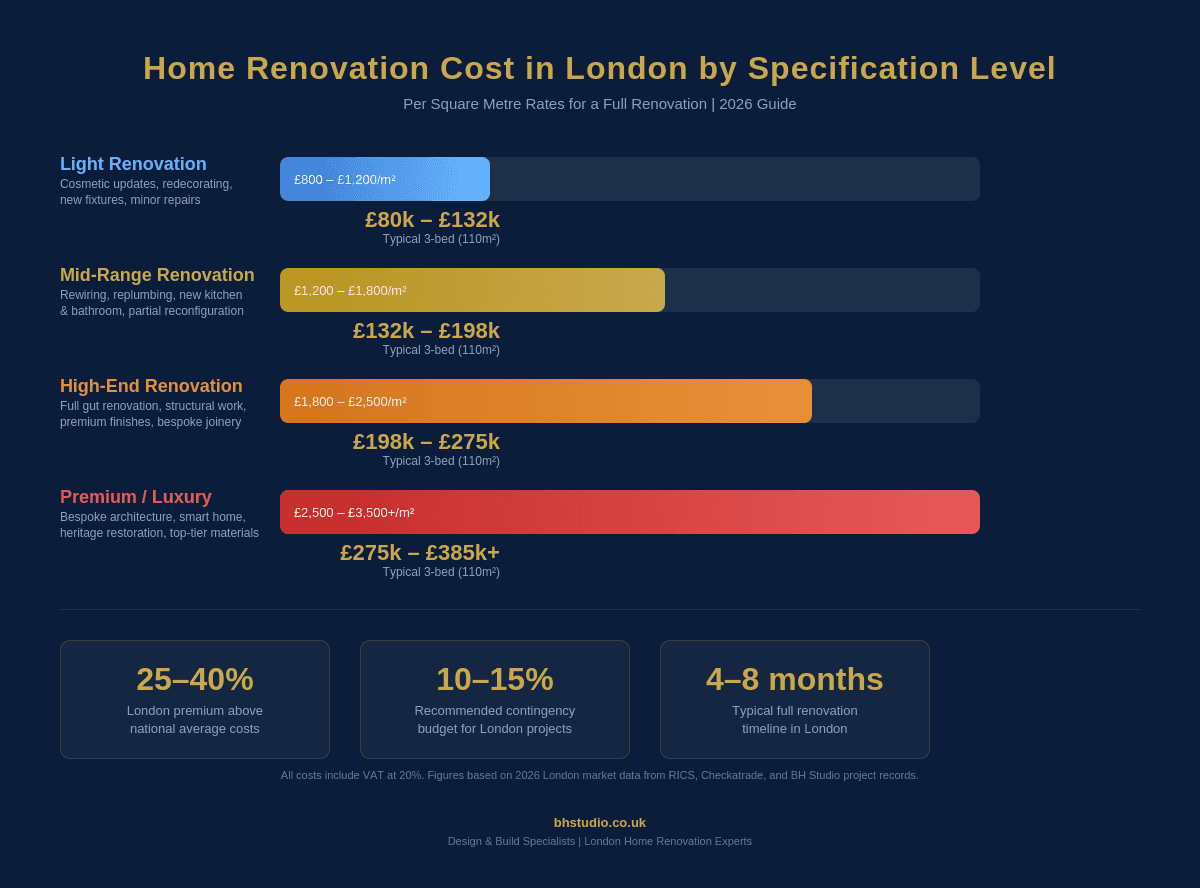
For a typical London 3-bedroom house of approximately 110 square metres, here is what you can realistically expect to pay at each specification level. A light renovation covering cosmetic updates, new fixtures, redecorating, and minor repairs costs between £80,000 and £132,000. A mid-range renovation that includes rewiring, replumbing, a new kitchen and bathroom, new heating system, and partial reconfiguration of the layout runs from £132,000 to £198,000. A high-end renovation involving full structural work, premium finishes, bespoke joinery, and underfloor heating throughout pushes the budget to between £198,000 and £275,000. Premium and luxury renovations - featuring bespoke architecture, smart home integration, heritage restoration, or top-tier materials - can exceed £275,000 to £385,000 and beyond.
These figures include VAT at 20 percent and cover all labour and materials, but they exclude major extensions, loft conversions, or basement digs. If your project includes any of those, you should budget an additional £50,000 to £150,000 or more depending on scope.
To apply these figures to your own project, try our home renovation cost calculator for a low/expected/high budget.
Renovation Cost per Square Metre in London (2026)
The most useful way to benchmark your renovation budget early on is the cost per square metre. In London, renovation costs per square metre in 2026 break down as follows. Light renovation work - redecorating, new flooring, updating fixtures - costs between £800 and £1,200 per square metre. Mid-range renovation that includes new systems, layout changes, and quality finishes runs £1,200 to £1,800 per square metre. High-end projects with structural alterations, premium materials, and bespoke design sit at £1,800 to £2,500 per square metre. Luxury and heritage restoration projects range from £2,500 to £3,500 or more per square metre.
These London rates are consistently 25 to 40 percent higher than the national average. The UK-wide mid-range sits at approximately £1,000 to £1,400 per square metre, while London's equivalent is £1,200 to £1,800. This premium is driven by several London-specific factors: higher skilled labour rates (London tradespeople typically charge 20 to 30 percent more than their counterparts in the Midlands or North), restricted site access in terraced streets, council parking and skip permits, scaffold licensing costs, and the prevalence of older properties that present more complex renovation challenges.
A critical point that catches many homeowners out: per square metre rates are estimates for early-stage budgeting. Your actual cost will depend on your property's specific condition, the extent of structural work required, the quality of finishes you select, and the complexity of planning or conservation area compliance. Always get a detailed, itemised quote from your contractor before committing - a single per-square-metre figure is a starting point, not a budget.
Home Renovation Costs by Room: A London Breakdown
Understanding how costs distribute across different rooms helps you prioritise your spending and identify where to invest for maximum impact - both for your daily living and for long-term property value. In our experience across hundreds of London renovation projects, the kitchen and bathrooms consistently account for 30 to 40 percent of the total budget. Here is a detailed room-by-room breakdown at London 2026 prices.
Kitchen Renovation Cost London
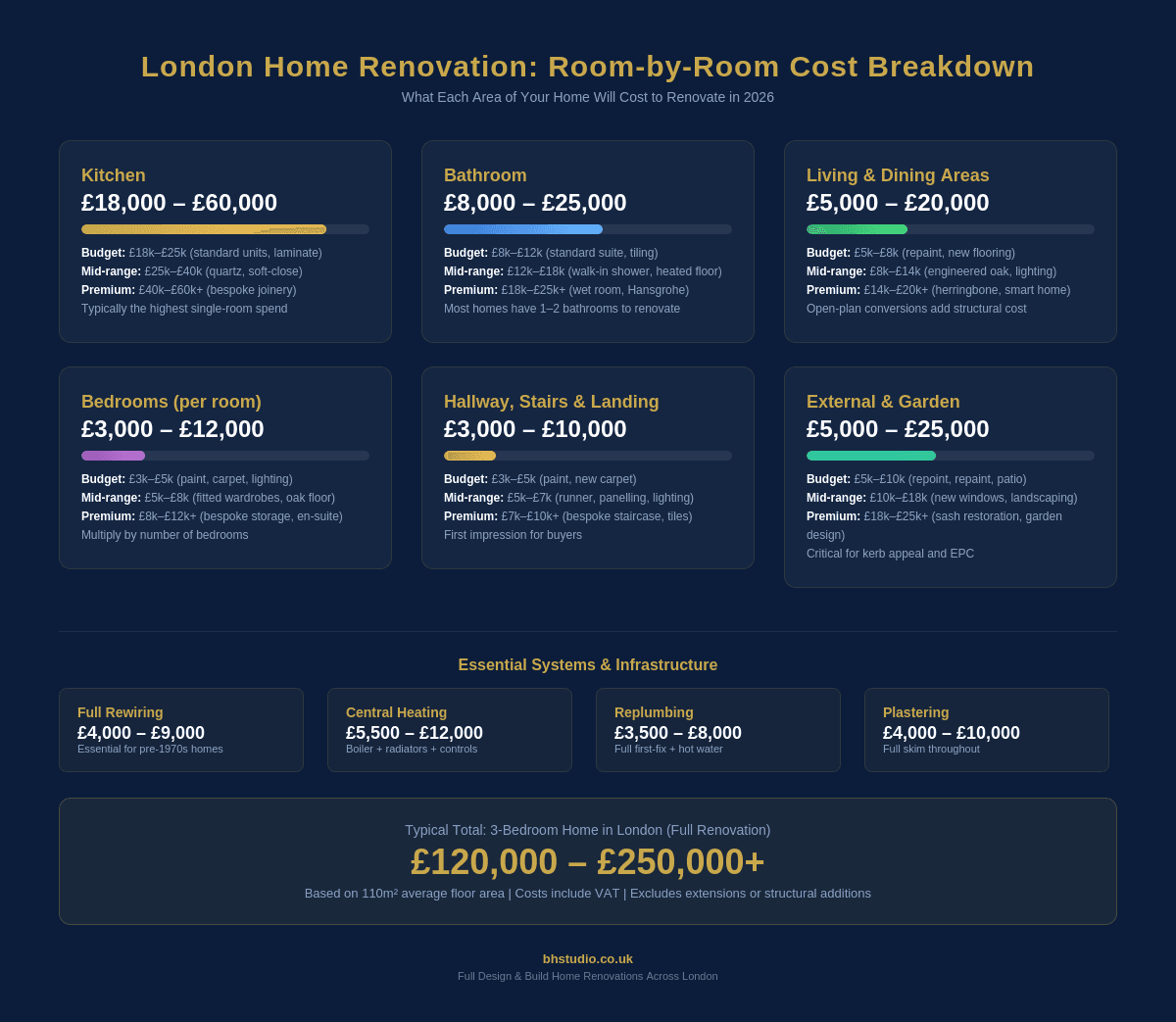
The kitchen is almost always the single highest-cost room in a London renovation, and for good reason - it combines plumbing, electrics, gas, ventilation, high-quality surfaces, and fitted furniture into a single concentrated space. In London, a kitchen renovation costs between £18,000 and £60,000 or more depending on size and specification. A budget kitchen with standard off-the-shelf units, laminate worktops, and mid-range appliances runs £18,000 to £25,000. A mid-range kitchen with quartz or granite worktops, soft-close hinges, integrated appliances, and quality tiling costs £25,000 to £40,000. A premium kitchen with bespoke joinery, stone surfaces, top-brand appliances, underfloor heating, and designer lighting can reach £40,000 to £60,000 or more.
If your renovation involves opening up the kitchen to create an open-plan kitchen-dining-living space - one of the most popular layout changes in London Victorian terraces - add the cost of a structural steel beam (typically £2,000 to £5,000 including installation) and the associated building regulations sign-off. This transformation is enormously popular across East and North London, where Victorian terraces often have small, separated rooms that feel cramped by modern standards.
Bathroom Renovation Cost London
Bathrooms are the second-highest cost per square metre of any room in the house, owing to the concentration of plumbing, waterproofing, tiling, and specialist fixtures in a compact space. A full bathroom renovation in London costs between £8,000 and £25,000 per bathroom. Budget renovations with a standard white suite, basic tiling, and standard chrome fittings come in at £8,000 to £12,000. Mid-range bathrooms with walk-in showers, quality porcelain tiles, heated towel rails, and underfloor heating cost £12,000 to £18,000. Premium bathrooms featuring wet-room design, stone tiles, designer sanitaryware from brands like Hansgrohe or Duravit, and bespoke vanity units run £18,000 to £25,000 or more.
Most London renovations involve at least one family bathroom and one en-suite or downstairs WC, so the total bathroom budget for a 3-bedroom home typically sits between £16,000 and £40,000 across all wet rooms.
Essential Systems: Rewiring, Plumbing, and Heating
The unglamorous but essential backbone of any full renovation is the building systems. These are the costs that first-time renovators most frequently underestimate, yet they are non-negotiable in older London properties. Full electrical rewiring for a 3-bedroom house costs £4,000 to £9,000, and it is essential for any property with original wiring dating from before the 1970s - which describes the vast majority of London's Victorian and Edwardian housing stock. A complete replumbing job runs £3,500 to £8,000. A new central heating system including boiler, radiators, pipework, and controls costs £5,500 to £12,000. Full replastering throughout typically adds £4,000 to £10,000.
These are not optional extras. If you are carrying out a full renovation in a period London property, your contractor will almost certainly recommend replacing all systems from scratch rather than patching into ageing infrastructure. The cost of doing it properly now is always less than the cost of remedial work later - and modern systems are significantly more energy efficient, reducing your running costs for years to come.
What Drives Home Renovation Costs Up in London?
London renovation costs are not simply "more expensive" than the rest of the UK - they are structurally different. The capital presents a unique set of challenges that affect both the price and the timeline of any renovation project. Understanding these factors will help you budget more accurately and avoid the nasty surprises that derail so many London renovations.
The London Premium Explained
London's 25 to 40 percent cost premium over national averages is driven by a combination of factors that compound on one another. Skilled tradespeople in London charge £200 to £350 per day compared to £150 to £250 in the Midlands. Parking permits for trade vehicles in CPZ zones can cost £15 to £40 per vehicle per day - and a busy site might have three to five vehicles at any time. Skip hire in London runs 30 to 50 percent more than elsewhere due to council permits, restricted placement hours, and higher landfill costs. Scaffold licensing from the local authority adds further cost, particularly in boroughs with narrow streets or Conservation Area restrictions where scaffolding design must be approved in advance.
Material delivery is also more expensive and more complex. Many London streets have restricted delivery windows - typically before 9am or after 4pm - and limited space for on-site storage, which means materials arrive in smaller, more frequent loads. All of this adds time and cost that simply does not exist on a suburban renovation in Surrey or Essex.
Property Age and Condition
London's housing stock is among the oldest in the country. In boroughs like Hackney, Islington, Walthamstow, and Crouch End, the majority of homes are Victorian or Edwardian terraces built between 1850 and 1910. These properties are beautiful, characterful, and often listed or within conservation areas - but they present renovation challenges that newer properties simply do not have.
Common issues include rising and penetrating damp (treatment costs £2,500 to £15,000), timber rot in suspended ground floors (£3,000 to £8,000 to address), subsidence and foundation movement requiring underpinning (£10,000 to £50,000 in extreme cases), asbestos in artex ceilings, pipe lagging, or roof tiles (survey and removal £500 to £5,000+), outdated lead plumbing and aluminium wiring, and chimney breast removal or stabilisation work. Our rule of thumb at Better Homes is to add 15 to 20 percent to any initial budget estimate for a Victorian property compared to an equivalent modern home. These older properties always have surprises behind the walls - and budgeting for them upfront is far less stressful than discovering them mid-project.
Conservation Areas and Planning Restrictions
Conservation-area status, listed-building status and Article 4 directions can affect what work is permitted. Check the specific address and proposed work with your local planning authority before allowing for fees and programme.
Conservation-area designation does not make every alteration a full planning application. Restrictions depend on the work and any local directions; listed-building consent is a separate consideration. Your architect should confirm the required approvals and suitable materials. See GOV.UK planning guidance and your council’s property-specific requirements.
Hidden Costs London Homeowners Miss
The gap between a quoted renovation price and the actual final bill is almost always caused by hidden costs - expenses that are not included in the builder's quote but are essential to completing the project. In London, these hidden costs can add £15,000 to £45,000 or more to your total spend. Here are the twelve most commonly overlooked expenses.
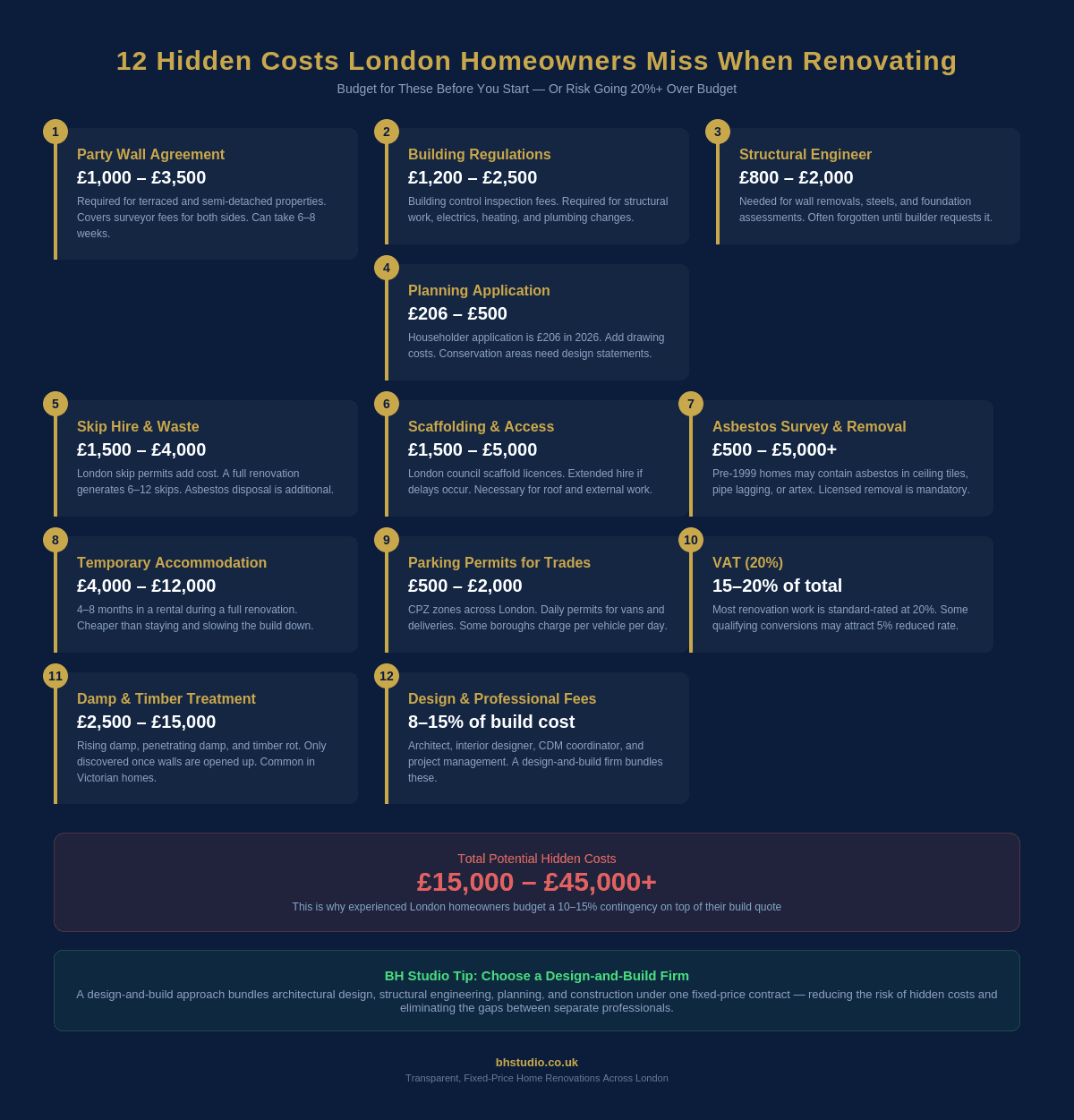
The Party Wall etc. Act 1996 applies to specified work on party structures, boundary walls and certain excavations. A notice does not always require a surveyor’s award: the route depends on the work and the neighbour’s response. Statutory notice periods are generally one or two months; allow longer if a dispute needs resolving. See the official party wall guidance. The £1,000 to £3,500 figure here is a planning allowance for professional costs, not a statutory charge. Building regulations fees of £1,200 to £2,500 cover the council building control inspections required for structural work, new electrics, heating, and plumbing changes. Structural engineer fees of £800 to £2,000 are needed for any wall removals, steel beam calculations, or foundation assessments. Skip hire and waste removal in London costs £1,500 to £4,000 for a full renovation, with council skip permits adding to the expense. Scaffolding and access costs £1,500 to £5,000 depending on duration and borough licensing requirements.
Asbestos is a significant risk in properties built before 1999. A survey costs £300 to £600, and licensed removal can run from £500 for minor areas to £5,000 or more for extensive contamination. Temporary accommodation during a full renovation typically costs £4,000 to £12,000 for four to eight months - and from our experience, vacating the property usually saves more in construction time than it costs in rent. Parking permits for trade vehicles across London's controlled parking zones add £500 to £2,000 over a typical project. VAT at 20 percent applies to almost all renovation work (some qualifying conversions may attract a reduced 5 percent rate). Damp and timber treatment, often discovered only after strip-out, adds £2,500 to £15,000. Finally, design and professional fees - covering architect, interior designer, principal designer where required, and project management - typically add 8 to 15 percent of the build cost.
At Better Homes, the quotation makes construction costs, professional fees and your chosen coordination support clear. We build the project, while your own or a recommended architect provides drawings and agreed submissions. If you want us to manage the coordination, we can handle discussions and follow up questions on your behalf, with your agreement. Professional services are not automatically included in a construction price.
Home Renovation Cost by London Property Type
Victorian Terrace Renovation Cost London
Victorian terraces are London's most common residential property type, making up approximately 60 to 70 percent of the housing stock in boroughs like Hackney, Walthamstow, Islington, and Crouch End. A full renovation of a 3-bedroom Victorian mid-terrace in London typically costs £120,000 to £220,000 for a mid-range to high-end specification. The higher end reflects the unique challenges of Victorian properties: suspended timber floors that need addressing, potential damp and structural movement, original features worth preserving (cornicing, ceiling roses, fireplaces), chimney breast removal or restoration, and the near-certainty that all systems (electrics, plumbing, heating) will need complete replacement.
The most popular renovation pattern we see in London Victorian terraces is opening up the ground floor to create an open-plan kitchen-living-dining space, renovating or adding a bathroom on the first floor, and converting the loft to create a third or fourth bedroom. This combination typically runs £150,000 to £250,000 depending on specification and whether the loft conversion is included in the scope.
Edwardian Semi-Detached Renovation
Edwardian semi-detached properties, common across North London areas like Muswell Hill, Finchley, and Crouch End, are typically larger than Victorian terraces - 120 to 150 square metres - and present slightly different renovation dynamics. These homes often have wider hallways, bigger rooms, and higher ceilings, which means more wall area to plaster, more floor area to finish, and longer pipe and cable runs. A full renovation of an Edwardian semi in London typically costs £140,000 to £280,000 at mid-range to high-end specification.
Edwardian semis are particularly well-suited to hip-to-gable loft conversions (adding £55,000 to £85,000) and side return extensions (adding £40,000 to £70,000), both of which can be incorporated into a comprehensive renovation to maximise the overall value uplift.
Modern Flat or Apartment Renovation
Renovating a modern flat in London is generally less complex than a period property - but not necessarily cheaper per square metre. Access restrictions, communal area regulations, leasehold requirements (including freeholder permissions and potential party wall implications with neighbours above and below), and limited working hours can all add cost and time. A full renovation of a 2-bedroom London flat of approximately 65 to 80 square metres typically costs £65,000 to £140,000 depending on specification and the extent of systems work required.
How Home Renovation Costs Vary by London Borough
Location within London has a meaningful impact on renovation costs. Inner London boroughs command a 15 to 25 percent premium over outer London for comparable work, driven by higher labour rates, more restrictive planning requirements, more complex site logistics, and the prevalence of conservation area designations that increase material and professional fee costs.
In Central London boroughs like Kensington, Chelsea, and Westminster, renovation costs per square metre routinely sit at £2,500 to £3,500 or more for mid-range to high-end work. In inner boroughs like Hackney and Islington, where Better Homes completes a significant volume of our projects, mid-range renovation costs typically fall between £1,400 and £2,200 per square metre. Property values are high enough (average Hackney property: approximately £550,000; average Islington property: approximately £650,000) that the value uplift from a well-executed renovation comfortably justifies the investment. In areas like Walthamstow, Crouch End, Muswell Hill, and Finchley - outer inner London, if you will - mid-range renovation costs sit at £1,200 to £1,800 per square metre, with slightly lower labour rates and fewer conservation area constraints making these some of the best value-for-money renovation locations in the capital.
Location affects both build costs and potential resale value. Compare local sold prices and seek independent valuation advice; spending the same amount in two different areas does not guarantee either a particular uplift or recovery of the budget.
Illustrative London Renovation Budgets: 3 Worked Examples
These illustrative budgets show how scope, floor area and specification shape the cost of a renovation. They are planning examples rather than completed-project costs or property valuations. Figures use 2026 planning assumptions including VAT; professional fees, statutory charges, finance costs, temporary accommodation and contingency should be budgeted separately unless explicitly included. The stated floor area is the assumed total area used in each calculation, including the loft in example 2. Obtain a measured scope and an itemised quotation for your property.
Example 1: Victorian Terrace, Hackney (E8)
Assume a full renovation of a 3-bedroom Victorian mid-terrace in Hackney, approximately 105 square metres. The scope included full internal strip-out and structural alterations to open up the ground floor, new kitchen with quartz worktops and integrated appliances, two new bathrooms (family bathroom and en-suite), complete rewiring, replumbing, and new central heating with a combi boiler, full replastering throughout, engineered oak flooring on all levels, new internal doors and joinery, and full redecoration. The assumed project cost is £148,000 including VAT; the programme requires a separate assessment. That works out to approximately £1,410 per square metre. If the assumed property value rises from £560,000 to £680,000, the £120,000 uplift recovers 81.1% of the £148,000 spend. Net ROI on spend is −18.9%, before other costs; this is an illustration, not a valuation or realised sale return.
Example 2: Edwardian Semi, Muswell Hill (N10)
A 4-bedroom Edwardian semi-detached property of approximately 135 square metres, this example allows for a full renovation plus a hip-to-gable loft conversion. The renovation scope covered a new high-specification kitchen with bespoke cabinetry, three bathrooms (master en-suite, family bathroom, ground-floor WC), full rewiring and new heating system with smart controls, structural alterations to improve ground-floor flow, restoration of original Edwardian features including cornicing, ceiling roses, and picture rails, and a new hip-to-gable loft conversion creating a master suite with en-suite and walk-in wardrobe. The total assumed project cost is £245,000 including VAT; no delivery period is promised. The per-square-metre cost (including loft conversion) was approximately £1,815. An assumed value change from £780,000 to £975,000 gives £195,000 uplift, 79.6% cost recovery and −20.4% net ROI on spend before other costs.
Example 3: Victorian Terrace, Walthamstow (E17)
A full renovation of a 3-bedroom Victorian terrace in Walthamstow, approximately 95 square metres, this example assumes a comprehensive but budget-conscious project. The scope included a mid-range kitchen with quality standard units and quartz worktops, one new family bathroom with walk-in shower, full rewiring, replumbing, and new boiler, replastering and redecoration throughout, new flooring (engineered wood ground floor, carpet bedrooms), and structural alteration to open kitchen into rear reception. The assumed project cost is £118,000 including VAT, working out to approximately £1,242 per square metre. An assumed property value change from £475,000 to £570,000 gives £95,000 uplift, 80.5% cost recovery and −19.5% net ROI on spend before other costs.
Renovate or Move? The London Cost Calculation
Compare the space each option delivers, its full cost and the disruption involved. The example below separates transaction costs, improvements and the purchase-price difference; it does not establish that renovation is always the better financial choice.
Illustrative moving-cost comparison: replacing a £600,000 main home with a £750,000 property has standard SDLT of £27,500 for a UK-resident buyer subject to the normal single-property rates (checked 14 September 2026). Add assumed agent fees of £9,000, legal costs of £4,000, survey/mortgage fees of £2,500 and removals of £2,500: £45,500 in transaction costs. An optional £10,000 redecoration allowance brings the initial outlay to £55,500, separate from the £150,000 purchase-price difference. Redecoration is not a transaction fee, and the price difference is not automatically additional mortgage debt. Higher rates or reliefs can change the tax. Check the official SDLT rates for your circumstances.
For comparison, a £140,000 to £165,000 renovation budget is an illustrative spending scenario, not an assured £120,000 to £150,000 value uplift. A renovation itself does not involve a property purchase attracting SDLT, but you still need to assess finance, temporary accommodation, fees and contingency. Existing mortgage terms and lender consent also need checking.
A loft conversion may create the extra room you need, subject to design, approvals and budget. Compare the total costs and practical outcomes of both options before deciding whether to renovate or move.
How to Budget for a London Home Renovation
Budgeting for a London renovation requires a more structured approach than most homeowners initially expect. The single biggest cause of renovation stress is not the cost itself - it is the gap between expectations and reality. Here is how to close that gap.
The Contingency Rule
Budget a minimum of 10 percent contingency on top of your quoted build cost. For Victorian or Edwardian properties, increase this to 15 percent. For listed buildings or properties with known structural issues, budget 20 percent. This contingency is not optional padding - it is a realistic allowance for the discoveries that emerge once walls are opened up, floors are lifted, and the true condition of the building fabric is revealed. In our experience, properties that have not been renovated in 20 or more years almost always reveal at least one significant surprise.
Phasing Your Renovation
If the total cost of a full renovation exceeds your available budget, a phased approach can work well - but it needs to be planned correctly from the outset. The optimal phasing strategy for a London home is to complete all structural and systems work first (strip-out, structural alterations, rewiring, replumbing, heating), then finish the ground floor including the kitchen and a functional bathroom, followed by first-floor bedrooms and additional bathrooms, and finally any loft conversion or cosmetic external work.
The critical mistake to avoid is doing cosmetic work before systems work. If you redecorate and then need to rewire a year later, you are paying twice for plastering and decorating. Plan the sequence with your contractor from the start, even if you are only executing the first phase immediately.
Energy Efficiency and Sustainable Renovation in London
Energy efficiency is no longer a nice-to-have in a London renovation - it is an essential consideration that affects both your running costs and your property's value. EPC ratings are increasingly scrutinised by buyers and lenders, and upcoming regulations are tightening the minimum standards for rental properties. Investing in energy efficiency during your renovation delivers both immediate savings and long-term value.
The most impactful energy upgrades to incorporate into a London renovation include insulation improvements (loft insulation £1,500 to £3,000, cavity wall insulation £1,000 to £2,500, internal wall insulation £4,000 to £10,000), a high-efficiency condensing boiler or air source heat pump (£5,000 to £15,000), double or triple glazing replacement windows (£5,000 to £15,000 for a typical 3-bed), LED lighting throughout (minimal additional cost if rewiring anyway), and smart heating controls with zoning (£500 to £2,000). The combined effect of these measures can improve your EPC rating by two to three bands, reduce energy bills by 30 to 50 percent, and add measurable value to your property. Homes with an EPC rating of C or above are increasingly preferred by buyers and command a premium in the London market.
If you are renovating a property that has been empty for two or more years, you may qualify for a reduced VAT rate of 5 percent instead of the standard 20 percent - a significant saving on a major renovation. Check HMRC VAT Notice 708, section 8 with your contractor: eligibility conditions and the type of work matter. Most renovation work is standard-rated at 20%.
How to Choose a Home Renovation Contractor in London
Choosing the right contractor is arguably the most important decision you will make in your renovation - more important than the tiles, the worktops, or the paint colours. A good contractor protects your budget, your timeline, and your sanity. A poor one can cost you tens of thousands in overruns and remedial work.
If you are past the research stage and want one accountable team to assess scope, budget and delivery risk, speak to our full home renovation team in London.
Bring your architect or choose an independent architect we recommend. We manage construction, with agreed coordination support. Our workmanship guarantee covers structural work, extensions and loft conversions for 10 years, bathroom and kitchen installations for 2 years, and decoration for 1 year. Item breakages are excluded from our workmanship guarantee and fall under the manufacturers’ own guarantees. Insurance cover up to £10 million. Ask for current certificates and the cover applicable to your project.
At Better Homes, design and build is a managed service: your architect prepares the drawings and agreed submissions, and we carry out the construction. Bring your own architect or choose one we recommend. With either route, you can ask us to coordinate discussions, follow up questions and speak on your behalf with your agreement. You approve the design, budget and changes; the proposal identifies the coordination support, appointments and fees.
Is a Full Home Renovation Worth It in London? ROI Analysis
Value uplift and profit are different. Cost recovery equals estimated value uplift divided by project spend. Net ROI on spend equals (estimated value uplift − project spend) divided by project spend. Recovering 60–85% of spend would mean £0.60–£0.85 of uplift per £1 spent and a net ROI of −40% to −15%, before other costs. These percentages explain the arithmetic; they are not a forecast of London renovation returns.
Value depends on the property, local comparables, the work undertaken and the market when you sell. Ask an independent local valuer to assess the proposed scope before relying on a resale uplift. An estimated valuation is not realised sale proceeds, and finance, fees and selling costs can reduce the eventual return.
Comfort, useful space, durability and the ability to stay in your neighbourhood can make renovation worthwhile even when the value uplift is less than the spend. Weigh those benefits separately from financial returns.
| Example | Spend incl. VAT | Assumed uplift | Cost recovery | Net ROI on spend |
|---|---|---|---|---|
| Hackney | £148,000 | £120,000 | 81.1% | −18.9% |
| Muswell Hill | £245,000 | £195,000 | 79.6% | −20.4% |
| Walthamstow | £118,000 | £95,000 | 80.5% | −19.5% |
Quick Takeaways
Budget realistically: A full London renovation costs £120,000 to £250,000+ for a 3-bed house - use £1,200 to £1,800 per square metre as your mid-range benchmark and add 10 to 15 percent contingency.
Kitchens and bathrooms dominate: Expect 30 to 40 percent of your total budget to go on wet rooms and the kitchen - and this is where buyers focus when valuing your home.
Hidden costs are real: £15,000 to £45,000 in party wall fees, building regs, VAT, skip hire, and unforeseen structural issues - budget for them upfront.
Victorian homes cost more: Add 15 to 20 percent to any estimate if your London property is Victorian or Edwardian - period properties always have surprises.
Compare moving and renovating: The illustrative move above has £45,500 in transaction costs plus £10,000 of optional redecoration. Compare this with the full renovation budget and your housing needs.
Separate recovery from profit: A £120,000 assumed uplift on £148,000 of spend recovers 81.1% of that spend; net ROI is −18.9% before other costs. Lifestyle benefits are separate.
Choose your level of support: Better Homes builds alongside your own or a recommended architect. Optional managed coordination means we can organise discussions and follow up questions, while you approve the design, budget and changes.
Planning Your London Renovation: Next Steps
A full home renovation in London is a significant financial commitment - but when executed well, it is one of the most rewarding investments you can make in both your property and your quality of life. The key to a successful outcome is not just the budget itself but the quality of the planning, the accuracy of the initial assessment, and the experience of the team managing the project from start to finish.
Use the guide to prepare a scope and compare quotations on the same basis. Review the assumptions against your property and budget before committing; market movements and a future sale price cannot be guaranteed.
Bring your architect or choose an independent architect we recommend. We manage construction, with agreed coordination support. Our workmanship guarantee covers structural work, extensions and loft conversions for 10 years, bathroom and kitchen installations for 2 years, and decoration for 1 year. Item breakages are excluded from our workmanship guarantee and fall under the manufacturers’ own guarantees. Insurance cover up to £10 million. Ask for current certificates and the cover applicable to your project.
Get your free renovation consultation →
Frequently Asked Questions: Home Renovation Cost London
How much does it cost to fully renovate a house in London in 2026?
A full home renovation in London costs between £120,000 and £250,000 or more for a typical 3-bedroom house of approximately 110 square metres. The exact cost depends on specification level, property condition, and the scope of structural work required. Light renovations start from £800 per square metre, mid-range renovations sit at £1,200 to £1,800 per square metre, and high-end projects can reach £2,500 to £3,500 per square metre or above.
How much is a renovation per square metre in London?
London renovation costs per square metre range from £800 for a cosmetic refresh to £3,500 or more for a premium transformation. The mid-range sits at £1,200 to £1,800 per square metre, which is 25 to 40 percent higher than the UK national average. The premium reflects London's higher labour rates, parking and skip permits, restricted site access, and the prevalence of older properties requiring more complex work.
How long does a full home renovation take in London?
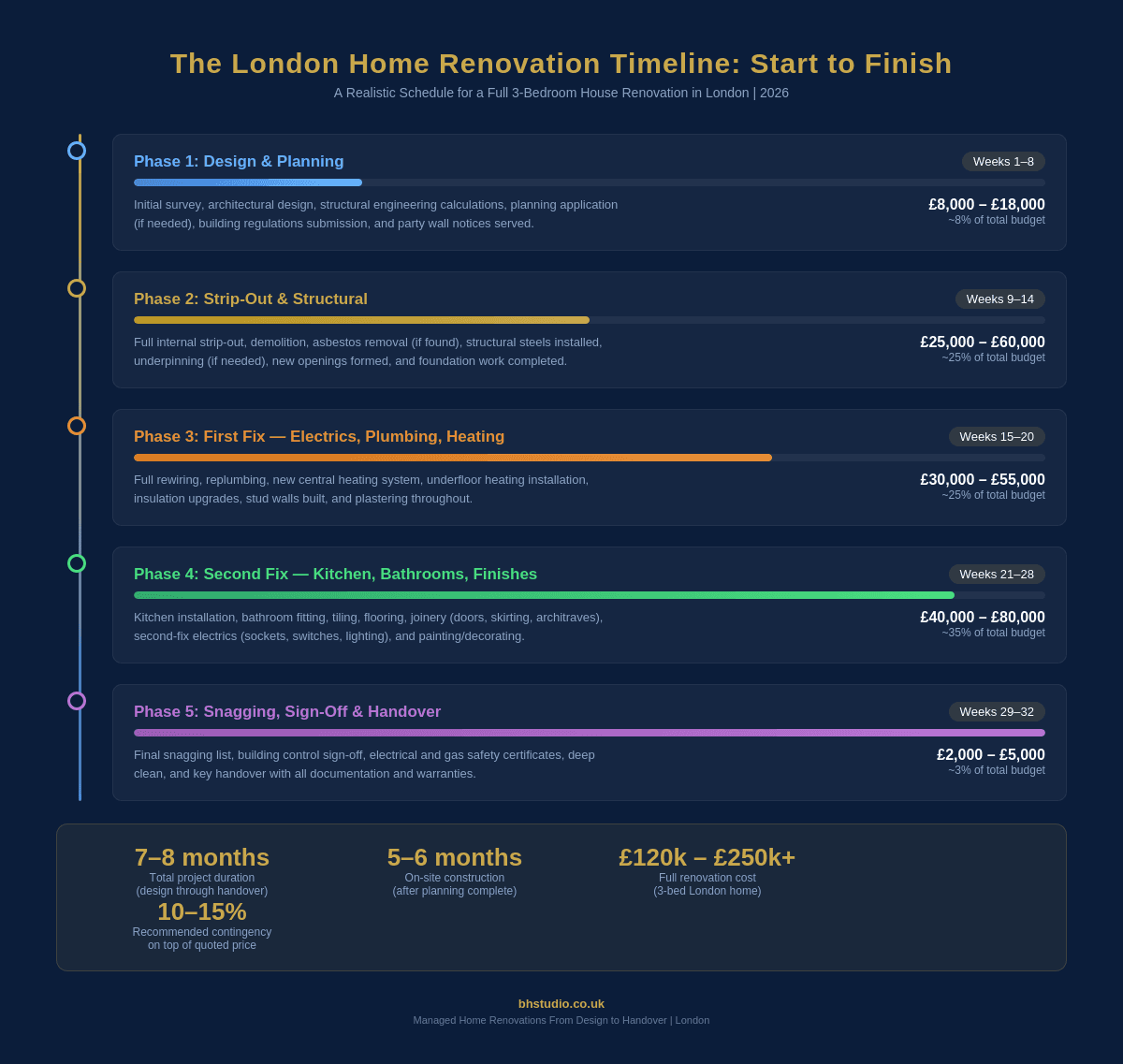
A full home renovation in London typically takes 7 to 8 months from initial design through to handover. This includes 6 to 8 weeks for design and planning, and 5 to 6 months for on-site construction. Projects involving planning applications, conservation area approvals, or loft conversions may take longer. The timeline is affected by the scope of structural work, the complexity of planning requirements, and the specification of finishes.
Is it cheaper to renovate or move in London?
In most cases, renovating is significantly cheaper than moving when you factor in stamp duty, estate agent fees, conveyancing costs, survey fees, and removal expenses. A typical London house move involves £55,000 or more in transaction costs that produce no asset value. A renovation, by contrast, adds value to your existing property while avoiding these costs entirely. The calculation becomes especially compelling when combined with a loft conversion to add bedrooms without moving.
How much contingency should I budget for a London renovation?
Budget a minimum of 10 percent contingency on top of your quoted build cost for a London renovation. For Victorian or Edwardian properties, increase this to 15 percent. For listed buildings or properties with known structural issues, budget 20 percent. This contingency covers the hidden costs and unforeseen discoveries that emerge once construction begins - issues that are virtually guaranteed in older London properties.
Does a full renovation add value to a London property?
A renovation can add value, but the uplift may be less than the cost. In our illustrative £148,000-spend / £120,000-uplift example, cost recovery is 81.1% and net ROI is −18.9% before other costs. Ask an independent valuer about your property; comfort and better use of space are separate benefits.
What is the most expensive room to renovate in London?
The kitchen is almost always the most expensive single room to renovate, costing £18,000 to £60,000 in London depending on specification. This is because kitchens combine plumbing, electrics, gas, ventilation, high-quality surfaces, and fitted furniture in a concentrated space. Bathrooms are the second most expensive per square metre, costing £8,000 to £25,000 each. Together, kitchen and bathrooms typically account for 30 to 40 percent of a full renovation budget.
If your renovation scope includes adding new floor area, compare these figures with our detailed guide to house extension costs in London or use our extension cost calculator before you finalise the budget.
Share Your Experience
Have you recently completed a home renovation in London? We would love to hear how your costs compared to the figures in this guide - whether they came in lower, higher, or right on target. Your experience helps other London homeowners plan more accurately. Drop us a message at bhstudio.co.uk/contact or share this guide with a friend who is planning a renovation. What was the biggest surprise cost in your project?
References and Sources
1. Royal Institution of Chartered Surveyors (RICS) - UK building cost data and regional renovation cost benchmarks. rics.org
2. Checkatrade - House renovation cost breakdown and UK tradesperson rates (2026). checkatrade.com
3. HM Government Planning Portal - Planning permission guidance, permitted development rights, and householder application fees. gov.uk/planning-permission
4. Federation of Master Builders (FMB) - Bathroom renovation cost benchmarks and contractor accreditation standards. fmb.org.uk
5. Energy Saving Trust - Energy efficiency improvement costs and savings data for UK homes. energysavingtrust.org.uk
Last updated: March 2026. All costs include VAT at 20% unless otherwise stated. Figures are based on 2026 London market data from industry sources and Better Homes project records.
Plan your project
Apply the guidance to your home.
Explore the scope and investment for your renovation, then discuss the work your home needs. See our London service areas for local project information.