 Better Homes
House extension · Home renovation
How to finance a house extension or renovation in London (2026 guide)
Complete 2026 guide to financing your London house extension, loft conversion or renovation. Compare remortgaging, further advances, loans, grants and move-vs-improve economics with London-specific costs.

How to Finance Your House Extension or Home Renovation in London (2026 Guide)
London homeowners typically finance house extensions and renovations through remortgaging (rates from 3.99–4.49% in March 2026), further advances from their current lender, second charge mortgages, or personal loans up to £35,000. For projects costing £50,000 to £130,000 – the typical range for London extensions and loft conversions – remortgaging is usually the most cost-effective route, provided you have sufficient equity (lenders typically allow borrowing up to 80–90% of your property's value). The government's Boiler Upgrade Scheme offers up to £7,500 towards heat pumps, while VAT on energy-saving materials remains at 0% until at least 2027. For most London homeowners, extending or converting is significantly cheaper than moving – stamp duty, agent fees and legal costs on a typical London move now exceed £25,000–£40,000, often more than the deposit needed to remortgage for an equivalent home improvement project.
Key Takeaways
Remortgaging is the most popular route – with average 5-year fixed rates around 4.40% in March 2026, remortgaging typically offers the lowest interest rate for projects over £25,000, especially for London homeowners sitting on significant equity gains.
Extending beats moving financially in London – the total cost of moving a London home (stamp duty, agents, legal, removals) ranges from £25,000 to £40,000+, money that never increases your property's value. By contrast, a loft conversion adds 20–25% to London property values.
Match your finance to your project size – personal loans suit projects under £25,000; remortgaging or further advances work best for £25,000–£150,000; bridging finance is for short-term renovation-and-sell strategies.
Government support is available but targeted – the Boiler Upgrade Scheme (£7,500 towards heat pumps), 0% VAT on energy-saving materials, and the new £15 billion Warm Homes Plan offer genuine savings when your extension includes energy efficiency improvements.
Always budget 10–15% contingency – London projects routinely encounter unexpected structural issues, party wall complications, or material cost increases. Lenders expect realistic total figures in finance applications.
A design-and-build firm simplifies finance – working with a single company that handles design, planning and construction (like Better Homes) means one fixed-price contract, clearer budgets for lenders, and fewer payment stage complications.
What This Guide Covers
How Much Will Your London Project Actually Cost?
Before exploring finance options, you need a realistic picture of what your project will cost. London construction costs are 25–40% above the national average due to higher labour rates, parking and scaffold licensing requirements, restricted site access on terraced streets, and the logistical complexities of building in a dense urban environment. Every financing decision – from how much to borrow to which product suits you best – flows from this number. Getting it wrong is one of the most common and most expensive mistakes London homeowners make.
Extension Costs by Type (London, 2026)
Single-storey rear extensions in London cost between £2,500 and £3,500 per square metre for a good-quality finish. A typical 20–30 sqm kitchen-diner extension comes in at £50,000 to £105,000 all-in. Side return extensions – hugely popular with Victorian terrace owners across Hackney, Islington and Walthamstow – cost £40,000 to £70,000 and can transform a narrow galley kitchen into an open-plan living space. Two- storey extensions deliver better value per square metre (£2,000–£3,000 per sqm) because the foundations and roof structure are shared, but total costs typically reach £80,000 to £180,000. Wraparound extensions combining side and rear sit at the premium end: £75,000 to £130,000 and almost always require full planning permission.
Loft Conversion Costs by Type (London, 2026)
Loft conversions remain one of London's most popular home improvements, adding a full bedroom, bathroom or home office without sacrificing garden space. A Velux (rooflight-only) conversion starts at £25,000 to £45,000. Rear dormer conversions – the most common type for Victorian terraces – cost £45,000 to £75,000. Hip-to-gable conversions for Edwardian semi-detached properties in areas like Muswell Hill and Finchley range from £55,000 to £80,000. L-shaped dormers, combining a rear and side dormer for maximum space, run £60,000 to £90,000. Mansard conversions, often the only option approved in conservation areas like those across Islington, start at £70,000 and regularly exceed £100,000 for high-specification finishes.
Full Renovation Costs (London, 2026)
A full house renovation in London varies enormously depending on scope. Cosmetic-only renovations (replastering, redecorating, new flooring, basic kitchen and bathroom refresh) typically cost £500 to £800 per square metre. Mid-range renovations including new kitchen, new bathroom, rewiring, replumbing and structural alterations cost £800 to £1,400 per sqm. High-end renovations with bespoke joinery, underfloor heating, smart home systems and premium finishes run £1,400 to £2,500+ per sqm. For a typical 3-bedroom Victorian terrace in East or North London, that translates to £80,000 to £200,000 depending on how ambitious your project is.
Hidden Costs London Homeowners Frequently Overlook
The builder's quote is just one piece of the budget puzzle. Architect and structural engineer fees add 10–15% of the total build cost. Planning application fees are £258 for a householder application in 2026. Building regulations approval runs £1,200 to £2,500. Party wall surveyor fees – required if your extension or loft conversion affects a shared wall – cost £1,000 to £3,000 per neighbour. Scaffold licence fees in London boroughs can add £500 to £1,500 depending on how long the scaffold stays up. Thames Water build-over agreements, skip permits, temporary parking suspensions and council-specific requirements all add up. As a rule, budget 10–15% above your builder's quote as a contingency fund. Lenders expect to see this level of financial realism in any application – and insufficient budgeting is one of the most common reasons mortgage applications stall or get declined.

Extend or Move? The London Financial Case
For many London homeowners, the decision isn't really "should I extend?" – it's "should I extend or move?" The financial arithmetic in London makes this question especially pointed. With average property prices above £500,000 across most of Central, East and North London, the transaction costs of moving are substantial – and unlike money spent on an extension, they don't add a single pound to your property's value.
Stamp Duty and Transaction Costs in London (2026)
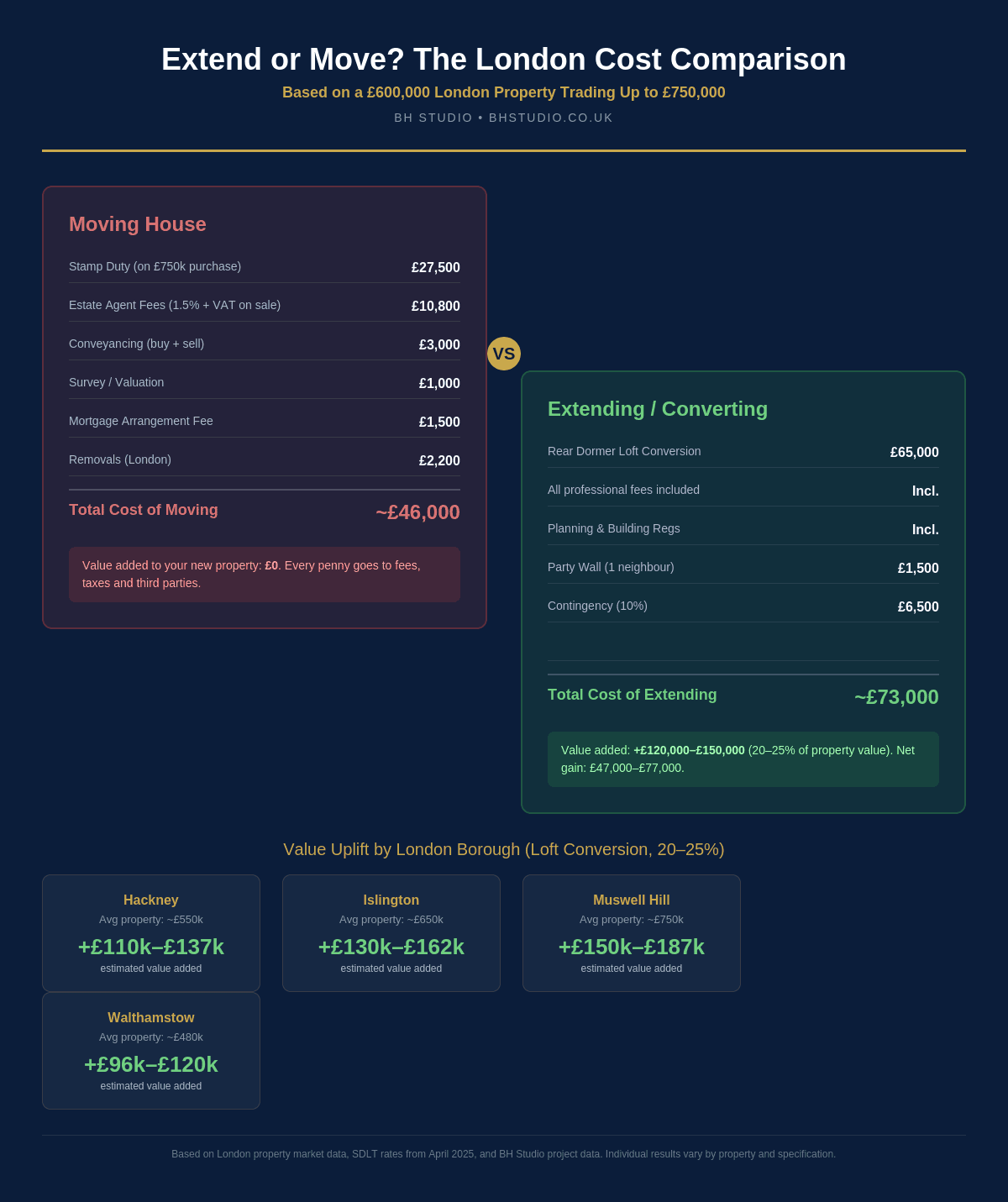
Since April 2025, stamp duty thresholds have reverted to their pre-2022 levels. The zero-rate threshold for home movers is now £125,000 (down from the temporary £250,000), and first-time buyer relief only applies up to £300,000 (down from £425,000). For a London homeowner trading up from a £600,000 property to a £750,000 property, the stamp duty bill alone is £27,500. Add estate agent fees (1–2% + VAT on the sale, typically £8,400–£14,400 on a £600,000 property), conveyancing costs for both buying and selling (£2,000–£4,000), survey fees (£600–£1,500), mortgage arrangement fees (£500–£2,000) and removals (£1,200–£3,000 in London), and the total cost of moving easily reaches £40,000 to £55,000.
That £40,000–£55,000 is money that disappears entirely into fees and taxes. It doesn't improve your new property. It doesn't add value. It is simply the cost of the transaction itself. Compare that to spending the same amount on a rear dormer loft conversion (£45,000–£75,000) or a single-storey extension (£50,000–£105,000), which directly adds 20–25% to your property's market value while giving you exactly the space you need, in the home and neighbourhood you already love.
Why Renovating Beats Moving for Most London Homeowners
The financial case is particularly strong in London's higher-value boroughs. In Hackney, where average property values sit around £550,000, a £75,000 dormer loft conversion can add approximately £120,000 to the property's value – a 60% return on the conversion cost itself. In Islington (average values around £650,000), a well-executed mansard conversion can add £130,000–£160,000. In Muswell Hill, where Edwardian semis average £750,000, a hip-to-gable conversion adds £150,000–£187,000 in value. These returns far exceed what you'd gain from the upheaval and expense of moving – and you avoid months of property chains, gazumping risk and the stress of finding the right home in a competitive market. The one exception: if your property physically cannot accommodate the space you need (very small plot, no loft height, already extended), moving may be the only practical option.
Remortgaging to Fund Your Extension or Loft Conversion
Remortgaging is the most common and typically the most cost-effective way to finance a house extension or loft conversion in London. It involves switching your existing mortgage to a new deal – either with your current lender or a new one – while increasing the amount you borrow to release equity for your building project. Because the loan is secured against your property, interest rates are significantly lower than personal loans or credit cards, and you can spread repayments over your full mortgage term.
How Remortgaging for Home Improvements Works
When you remortgage, your new lender pays off your existing mortgage and provides you with a new, larger mortgage. The difference between what you owed on your old mortgage and the new mortgage amount is released to you as cash, which you can then use for your extension, loft conversion or renovation. For example, if your current mortgage balance is £300,000 and your property is valued at £600,000, you have £300,000 in equity. If you remortgage to £375,000 (62.5% LTV), you release £75,000 for your building project while maintaining a comfortable loan-to-value ratio. The entire process typically takes 4–8 weeks from application to completion.
Current Remortgage Rates (March 2026)
As of March 2026, the mortgage market offers competitive rates for homeowners with good equity positions. The average 5-year fixed remortgage rate sits at approximately 4.40%, with the best deals available from 3.99% at 90% LTV and around 3.75% at lower LTV ratios. Two-year fixed deals average around 4.25%. For London homeowners who purchased before the 2022 rate rises, the picture is nuanced: if you locked in a sub-2% deal during 2020–2021, any new rate will be higher. However, the key comparison isn't your old rate versus the new rate – it's the cost of the remortgage versus alternative financing options. At 4.40%, borrowing an additional £75,000 over 25 years costs approximately £413 per month. A personal loan for the same amount (if available) would cost significantly more at typical unsecured rates of 6–10%.
How Much Equity Do You Need?
Lenders typically allow you to borrow up to 80–85% of your property's current value, with some stretching to 90% for borrowers with strong income and credit profiles. The calculation is straightforward: take your property's current market value, multiply by the maximum LTV your target lender allows, and subtract your current mortgage balance. The result is the maximum amount you could release for your project. London homeowners are often well-positioned here because property values across the capital have risen substantially over the past decade, building significant equity even for those who bought relatively recently. A property purchased for £450,000 in 2018 that's now worth £575,000 has generated £125,000 in equity growth alone, before accounting for mortgage repayments.
Pros, Cons and What to Watch For
The main advantages of remortgaging for home improvements are clear: lower interest rates than any unsecured borrowing, longer repayment terms that keep monthly costs manageable, and the ability to raise large sums (£50,000–£200,000+) that match the scale of London building projects. However, there are important considerations. Early repayment charges on your existing mortgage can be substantial – typically 1–5% of the outstanding balance, which on a London mortgage could mean £3,000–£15,000. If you're mid-way through a fixed-rate deal, the cost of exiting early may outweigh the benefits. Arrangement fees on the new mortgage (£500–£2,000) add to the cost. And critically, you're increasing the debt secured against your home – if you can't keep up repayments, your home is at risk. Always ensure the monthly increase is comfortably affordable, even if interest rates rise in the future. A qualified mortgage broker can model different scenarios and help you find the optimal deal structure for your circumstances.
Further Advance from Your Current Lender
A further advance is borrowing additional money from your existing mortgage lender, on top of your current mortgage, without switching providers. Think of it as asking your current bank for a top-up. It's one of the simplest financing routes and often the fastest, because your lender already has your property details, income verification and payment history on file.
How a Further Advance Works
Your current lender agrees to lend you an additional amount, secured against your property. This additional borrowing sits alongside your existing mortgage but typically on a separate interest rate and term. So you might have your original mortgage of £280,000 at 2.1% (locked in during 2021) and a further advance of £65,000 at 4.5% (today's rate). Each portion is repaid according to its own terms. This structure has a significant advantage: you don't need to break your existing deal and potentially pay early repayment charges. If you're sitting on a competitive rate from before the 2022 increases, a further advance preserves that rate on the bulk of your borrowing.
When a Further Advance Makes Sense
A further advance is typically the best option when you have a favourable existing mortgage rate that you don't want to lose, particularly if you're within the early repayment charge period. It's also simpler administratively – no conveyancing, no new lender assessment from scratch – and can sometimes be arranged within 2–4 weeks. The main drawback is that your current lender may not offer the most competitive rate on the additional borrowing, and they may have stricter lending criteria for further advances than a new lender would for a full remortgage. Always compare what your existing lender offers against what the broader market provides. A mortgage broker can run this comparison for you in minutes.
Second Charge Mortgages (Secured Loans)
A second charge mortgage – also called a secured loan or second mortgage – allows you to borrow against your property's equity without disturbing your existing mortgage at all. The second lender takes a "second charge" on your property, meaning they get repaid after your primary mortgage lender if the property is ever sold or repossessed. This structure means you keep your original mortgage completely intact, making it particularly attractive if you have an exceptionally low rate from the pandemic era.
Rates, Terms and Suitability
Second charge mortgage rates are typically higher than first mortgage rates – expect 5.5% to 8% depending on your equity position, credit profile and the amount borrowed. Terms range from 3 to 25 years. While the rate premium compared to a remortgage is notable, the total cost calculation can still favour a second charge if your existing first mortgage rate is very low. Consider this scenario: you have £350,000 outstanding at 1.8% fixed until 2027, with early repayment charges of 4%. Remortgaging would mean paying £14,000 in exit penalties plus losing your 1.8% rate on the entire balance. A second charge of £70,000 at 6.5% keeps the low rate on £350,000 while only paying the higher rate on the £70,000 additional borrowing. A broker can model both scenarios to show which is genuinely cheaper over the deal period.
Second charge mortgages suit London homeowners who have substantial equity, an existing mortgage at an excellent rate they don't want to break, and a clear building project with defined costs. They are regulated by the Financial Conduct Authority, so you'll receive the same level of consumer protection as with a standard mortgage. The key risk is the same as any secured borrowing: your property is used as collateral, and you'll be making repayments on two separate loans.
Personal Loans for Smaller Projects
For London projects under £25,000 – perhaps a high-quality bathroom renovation, a basic Velux loft conversion, or the finishing costs on a larger project that's mostly funded from savings – an unsecured personal loan can be the simplest and fastest route. No valuation is needed, no property is put at risk, and funds can be available within days. Lenders like Novuna offer home improvement loans up to £35,000 with rates from 6.3% APR representative (for amounts between £7,500 and £25,000), and repayment terms of 2 to 7 years.
When Personal Loans Work – and When They Don't
The advantages are speed, simplicity and the fact that your home isn't used as security. If you can't make the repayments, the consequences are serious for your credit rating but your home isn't at immediate risk. However, the cost of borrowing is significantly higher than mortgage-based options. At 6.3% APR, borrowing £25,000 over 5 years costs approximately £486 per month, with total interest of around £4,200. The same amount added to a mortgage at 4.4% over 25 years costs only £138 per month, though the total interest paid would be higher due to the longer term. Personal loans make the most sense for smaller projects where the simplicity and speed of access outweigh the higher rate, or for topping up a larger project that's mainly funded through equity release or savings.
Bridging Finance for Renovation Projects
Bridging loans are short-term, high-interest products designed to "bridge" a financial gap – typically between buying a property and selling another, or between completing a renovation and refinancing onto a standard mortgage at the improved property value. They are not a mainstream option for most homeowners extending their family home, but they play an important role in specific scenarios.
How Bridging Loans Work for Renovations
Bridging lenders charge interest monthly rather than annually – typically 0.5% to 1% per month (equivalent to 6–12% annually). Terms usually run from 1 to 18 months. You can choose to pay interest monthly or "roll up" the interest into the principal, repaying everything when the loan term ends. This rolled-up structure is common for renovation projects where the borrower expects to remortgage or sell once the work is complete. A key advantage is speed: bridging loans can be arranged in as little as 3–7 days when all documentation is ready. They also accommodate properties and situations that standard lenders won't touch – for instance, a property that's currently uninhabitable due to major structural work.
In London, bridging finance is most commonly used by homeowners who have purchased a property that needs significant renovation before it qualifies for a standard mortgage, or by those undertaking a renovation-and-sell strategy where the post-renovation property value will support a more favourable remortgage. It is rarely the right choice for a straightforward extension on your existing family home – the costs are simply too high for a project you'll be living in throughout. Always exhaust remortgage, further advance and second charge options before considering a bridging loan for a home improvement project.
Specialist Renovation Mortgages
A small but growing number of UK lenders offer specialist renovation mortgages designed specifically for properties that need significant work. Unlike standard mortgages, these products release funds in stages as the renovation progresses, rather than providing the full amount upfront. This staged approach mirrors how construction projects actually work – you don't need £150,000 on day one; you need it released in line with the build programme.
How Staged Release Mortgages Work
With a renovation mortgage, the lender provides an initial advance (typically enough to purchase the property or cover the first phase of work) and then releases further tranches as the project hits agreed milestones – foundations complete, shell built, first fix done, and so on. A surveyor visits at each stage to confirm the work meets the required standard before the next tranche is released. This protects both the lender and you: you're never over-exposed, and the lender can see that funds are being used productively. Ecology Building Society, one of the UK's leading renovation mortgage providers, releases up to 80% (or 90% on their higher tier) of the property's increasing value at each stage, with a maximum loan of £1.25 million. They recommend having 15–20% of your total project budget available as cash to fund the early stages before the first release. A notable feature of Ecology's product is their C-Change discount: once your renovation improves the property's energy performance, your interest rate reduces by 0.25% to 1.50%, rewarding energy-efficient improvements.
Renovation mortgages are best suited to homeowners purchasing a property in need of major work, or to those undertaking whole-house renovations where a standard remortgage wouldn't cover the full scope. They require more administration than a straightforward remortgage – stage inspections, multiple drawdowns, potentially higher arrangement fees – but for the right project, they provide a structured, disciplined financing framework that keeps your renovation on budget and on track. If you're working with a design-and-build company that provides a detailed build programme and fixed-price contract, the staged release structure aligns naturally with how the project is managed.
Government Grants and Energy Schemes (2026)
While there's no direct government grant for a standard house extension or loft conversion, several schemes can significantly reduce costs when your project includes energy-efficiency improvements – which, given current Building Regulations requirements, most London projects now do by default.
Boiler Upgrade Scheme (BUS) – Up to £7,500
The Boiler Upgrade Scheme provides grants of up to £7,500 towards the installation of air-source or ground-source heat pumps in England and Wales. If your extension or renovation includes replacing a gas boiler with a heat pump – an increasingly common choice in new London extensions – this grant directly reduces your project cost. The scheme has been extended to 2030, and the grant is applied for by your registered installer rather than by you directly. To qualify, your property must have a valid Energy Performance Certificate with no outstanding recommendations for loft or cavity wall insulation. If your project includes loft insulation as part of a loft conversion, you'd need to ensure that's completed before the BUS application for the heat pump.
0% VAT on Energy-Saving Materials
Since 2022, energy-saving materials and installations carry 0% VAT in the UK, and this relief is confirmed until at least 2027. This includes insulation, heat pumps, solar panels, and energy-efficient glazing upgrades. For a loft conversion where insulation is a significant component, or an extension where you're installing underfloor heating connected to a heat pump, the VAT saving can be substantial. On a £15,000 insulation and heating package, the difference between 20% VAT and 0% VAT is £3,000 – real money that reduces your borrowing requirement.
The Warm Homes Plan – £15 Billion in Government Investment
The UK Government's Warm Homes Plan, announced in early 2026, is the largest home energy efficiency programme in British history. With £15 billion committed to upgrading up to 5 million homes by 2030, it includes grants for low-income households and, crucially for London homeowners, low and zero-interest loans through the new Warm Homes Fund for broader home energy upgrades including solar panels, batteries and heat pumps. Full details of the loan scheme are expected later in 2026, but the direction is clear: the government is creating new, cheaper financing routes for homeowners who include energy efficiency in their renovation plans. The new Warm Homes Agency, expected to launch in 2027, will provide impartial advice on available support. Meanwhile, the ECO4 scheme (providing free insulation and heating upgrades for eligible low-income households) closed to new applications in early 2026, with its successor ECO5 expected to launch from April 2026 with updated criteria.
Green Mortgages – Better Rates for Efficient Homes
An emerging trend worth considering: several UK lenders now offer "green mortgage" products with discounted interest rates for energy-efficient properties. If your extension or renovation significantly improves your home's EPC rating – for example, from band D to band B – you may qualify for a lower mortgage rate when you remortgage after completion. This creates a virtuous cycle: borrow to improve your home's energy efficiency, then benefit from lower borrowing costs as a result. When planning your project, ask your architect or design-and-build company specifically about measures that will improve your EPC rating, as the long-term financial benefits extend well beyond the energy bill savings.

Savings vs Borrowing: The Real Cost Comparison
If you have savings available, using them to fund part or all of your project avoids interest payments entirely. But the decision isn't as straightforward as it first appears. There's an opportunity cost to deploying a large sum of savings into bricks and mortar, and legitimate financial arguments on both sides.
The Case for Using Savings
The most obvious benefit is that you pay no interest at all. If your extension costs £80,000 and you pay from savings, you avoid paying £35,000–£50,000 in interest over a 25-year mortgage term (at current rates). You also avoid monthly repayment obligations, keep your mortgage balance unchanged, and maintain full flexibility with your finances going forward. For homeowners who have been disciplined savers and have funds specifically earmarked for home improvements, this is often the cleanest approach.
The Case for Borrowing
The counter-argument centres on two factors: opportunity cost and liquidity. Money tied up in your property isn't easily accessible in an emergency. If you use £80,000 of savings for your extension and then face an unexpected expense six months later, you may find yourself borrowing at unfavourable terms to cover it. Maintaining a healthy savings buffer (typically 3–6 months of household expenses) is a fundamental financial safety net that most advisers recommend keeping intact. Additionally, if your savings are earning reasonable returns in investments or high-interest accounts (some currently paying 4.5–5%), and you can borrow at 4–4.5% on a mortgage, the mathematical difference may be marginal – particularly when you factor in the tax-free nature of ISA returns.
A pragmatic middle ground that many London homeowners adopt is a blended approach: use savings to cover a portion (perhaps 30–50% of the project cost), borrow the remainder through a remortgage or further advance, and keep your emergency fund untouched. This reduces total interest paid while maintaining financial resilience. There is no universally "right" answer – it depends entirely on your personal financial circumstances, risk tolerance and future plans.
How to Choose the Right Finance Option for Your Project
With multiple financing routes available, choosing the right one requires matching your project's characteristics to your financial situation. Here's a practical decision framework that cuts through the complexity.
Decision Framework by Project Size
For projects under £25,000 (high-end bathroom renovation, basic Velux conversion, finishing costs), an unsecured personal loan is likely the simplest option. No valuation, no property risk, funds available in days. For projects between £25,000 and £150,000 (most London extensions, dormer and mansard loft conversions, kitchen extensions), a remortgage or further advance will almost always offer the best rates. The choice between the two depends on whether your current mortgage rate is worth protecting. For projects over £150,000 (full house renovation, wraparound extension combined with loft conversion, basement dig), a remortgage provides the scale of borrowing needed, or a staged renovation mortgage may suit if the project is particularly complex.
Decision Framework by Financial Situation
If you have a current mortgage rate below 3% with years remaining on the fix, a further advance or second charge preserves that rate while funding your project. If your current deal is ending within 6 months, a remortgage lets you refinance at today's best rates while releasing funds – killing two birds with one stone. If you're a cash buyer with no mortgage, a new mortgage or personal loan are your primary options. If you have substantial savings but want to maintain liquidity, a blended approach (part savings, part borrowing) offers the best of both worlds. In every case, speak to a qualified mortgage broker before committing. Brokers have access to the full market and can model the true cost of each option based on your specific numbers.

How Your Extension or Loft Conversion Adds Value in London
Understanding the value your project will add isn't just academically interesting – it's directly relevant to your financing. The post-renovation value of your property affects your loan-to-value ratio, the rates available to you if you remortgage after completion, and whether your project qualifies as a sound investment in a lender's eyes. In London, the value uplift from extensions and conversions is among the highest in the UK, making the financial case for borrowing to improve your home particularly compelling.
ROI by Project Type in London
Loft conversions consistently deliver the highest return on investment of any home improvement project in London, adding 20–25% to property values in inner London boroughs and 15–18% in outer London. A £75,000 dormer conversion on a £600,000 Hackney terrace generates approximately £120,000 in additional value – a 60% return on the conversion cost. Rear extensions add 10–15% to property values, with the exact return depending heavily on how the new space integrates with the existing ground floor layout. Kitchen extensions that create open-plan living-dining-cooking spaces consistently achieve the highest returns in this category. Full house renovations are harder to generalise, but a well-executed renovation of a tired Victorian property in a desirable London postcode can transform a property from "needs work" pricing to full market value – a differential that often exceeds the renovation cost itself.
Borough-Level Value Uplift Data
The value equation varies significantly by borough. In Hackney (average property value approximately £550,000), a loft conversion adding 20–25% represents £110,000 to £137,000. In Islington (approximately £650,000), the same percentage translates to £130,000 to £162,000 – reflecting both the higher base values and the premium that buyers in these boroughs place on additional accommodation. Muswell Hill properties (averaging around £750,000) see value increases of £150,000 to £187,000 from well-executed loft conversions. Even in more affordable areas like Walthamstow (approximately £480,000), a £50,000–£85,000 conversion adds £96,000–£120,000 in value. This consistent premium across London boroughs is what makes loft conversions and extensions such a compelling use of borrowed funds: you're not just spending money, you're converting it into property equity at a ratio that substantially exceeds the cost of the borrowing itself.
Step-by-Step: Securing Finance for Your London Project
Whether you're remortgaging, taking a further advance, or applying for a personal loan, following a structured process ensures you secure the right deal without delays. Here's the sequence we recommend based on working with hundreds of London homeowners through the financing and building process.
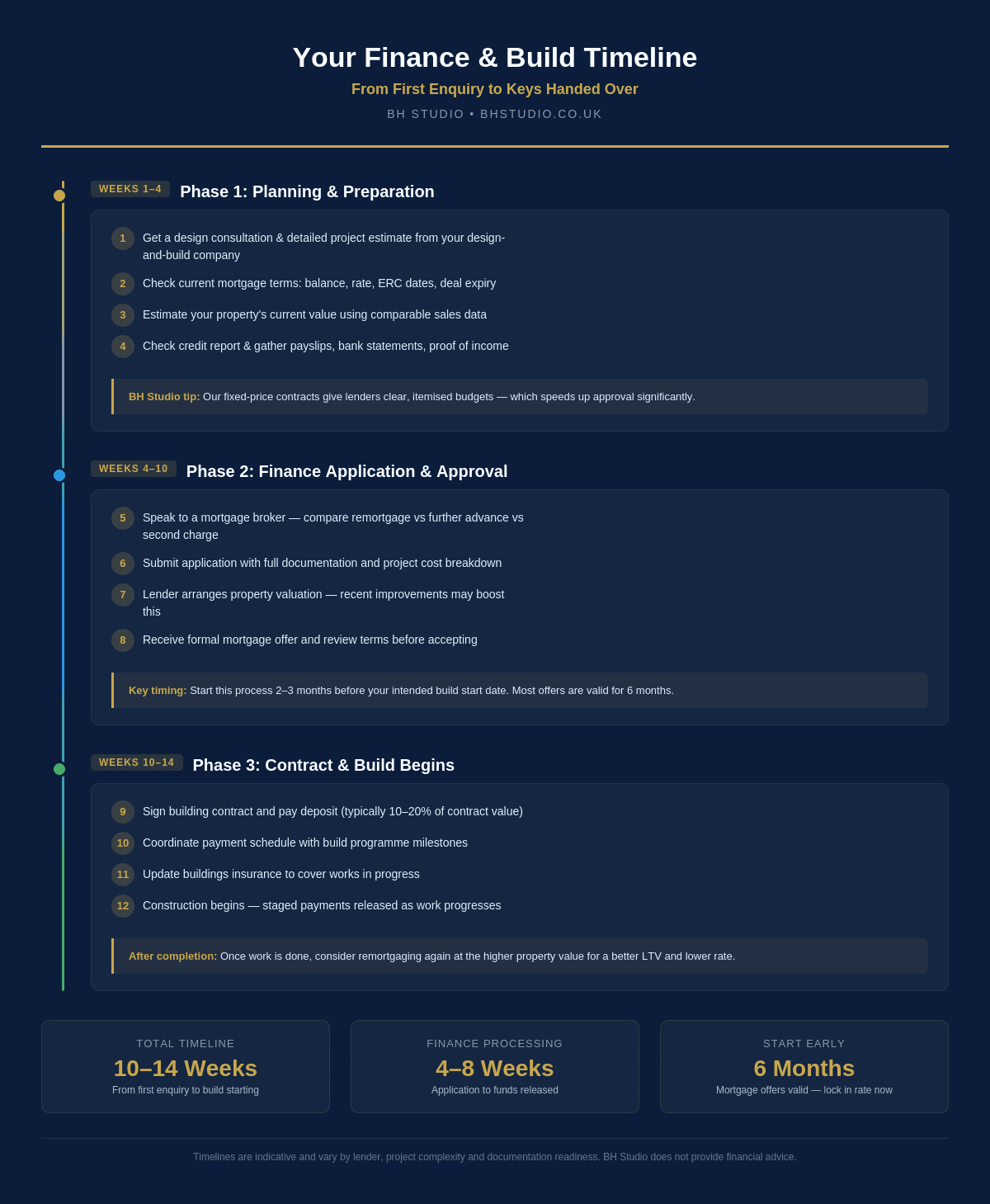
Phase 1: Pre-Application (4–8 Weeks Before You Need Funds)
Start by getting clear on your total project budget, including all professional fees, statutory costs and a 10–15% contingency. If you're working with a design-and-build company, request a detailed cost breakdown and fixed-price quote – lenders are far more comfortable approving finance when they can see a clear, itemised budget from a single accountable contractor. Check your current mortgage terms: what's your outstanding balance, current rate, any early repayment charges, and when does your deal expire? Get an up-to-date valuation of your property – either through a professional valuation or by reviewing recent comparable sales on your street. Check your credit report for any issues that could delay an application. Gather payslips, bank statements, and proof of any additional income.
Phase 2: Application and Approval (4–8 Weeks)
Speak to a mortgage broker to compare options across the full market. A good broker will model the true cost of a remortgage versus a further advance versus a second charge, factoring in your specific existing deal, early repayment charges, and the rate environment. Once you've chosen a route, submit your application with all supporting documentation. For remortgages, the lender will arrange a property valuation – this is where recent improvements can work in your favour, as a higher valuation improves your LTV and potentially unlocks better rates. For further advances, the process is typically faster since your lender already holds your information. Most mortgage applications complete within 4–8 weeks, though this can vary by lender and complexity.
Phase 3: Coordination with Your Build Programme
Time your finance to align with your construction start date. Most builders require a deposit (typically 10–20%) at contract signing, with the remainder paid in stages throughout the build. If you're remortgaging, you'll receive the full additional funds when the remortgage completes – so begin the finance process 2–3 months before you expect to sign the building contract. If your builder offers staged payments, consider how your cashflow will work across the project timeline. Ask for a clear construction payment schedule and separate details of professional fees and any coordination support. At Better Homes, those costs and appointments are set out in your proposal so you can plan payments across the whole project and discuss the documentation your lender needs.
Quick Takeaways
1. Remortgaging is the most cost-effective way to finance projects over £25,000, with rates from approximately 3.99% in March 2026 – significantly cheaper than personal loans or credit cards.
2. The cost of moving house in London (£25,000– £55,000 in stamp duty, fees and costs) often exceeds the deposit needed to remortgage for an equivalent-value extension or loft conversion – and moving costs add zero value to your new property.
3. If your current mortgage rate is below 3% and you're within the fixed-rate period, a further advance or second charge mortgage preserves your low rate on the existing balance while funding your project at today's rates.
4. Government support through the Boiler Upgrade Scheme (£7,500), 0% VAT on energy-saving materials, and the forthcoming Warm Homes Plan loans can reduce your borrowing requirement by £5,000–£10,000+ on projects that include energy efficiency improvements.
5. London loft conversions add 20–25% to property values, meaning a £75,000 project on a £600,000 property generates approximately £120,000 in equity – the borrowing effectively pays for itself and then some.
6. Always budget 10–15% contingency above your builder's quote, and present lenders with a realistic total figure that includes all professional fees, statutory costs and unexpected variables.
7. Start the financing process 2–3 months before your intended build start date to allow for application processing, valuation and any conditions the lender requires.
Frequently Asked Questions
Can I remortgage specifically to fund a loft conversion in London?
Yes. Remortgaging to fund a loft conversion is one of the most common reasons London homeowners release equity. Lenders view loft conversions favourably because they add measurable value to the property – typically 20–25% in London – which improves the lender's security position. You'll need sufficient equity (most lenders allow borrowing up to 80–90% LTV), a clean credit history, and evidence that you can afford the increased monthly repayments. Some lenders will ask for details of the planned work, including quotes and planning information, so having a fixed-price contract from your builder strengthens the application.
What's the cheapest way to finance a £60,000–£80,000 extension in London?
For most homeowners, remortgaging or taking a further advance offers the lowest cost of borrowing for projects in this range. At current rates (approximately 4.40% on a 5-year fix), the monthly cost of borrowing £70,000 over 25 years is around £385. A personal loan for the same amount would be significantly more expensive, if available at all – most personal loans cap at £25,000–£35,000. The cheapest approach of all is using savings if you have them, but maintaining a financial safety buffer is important. A blended approach – part savings, part remortgage – is the most common strategy for London homeowners in this project range.
Do I need to tell my mortgage lender about my extension or loft conversion?
Yes, you should inform your mortgage lender before starting major building work. Most mortgage terms require you to notify the lender of structural alterations. This protects both you and the lender – the work will affect the property they hold as security. You'll also need to update your buildings insurance to cover the work during construction and the increased rebuild value once it's complete. Your home insurance provider needs to know about the project too; failure to inform them could invalidate your cover.
Can I get a government grant for a house extension in London?
There is no direct government grant for a standard house extension or loft conversion. However, if your project includes energy-efficiency improvements – which is increasingly common given current Building Regulations – you may benefit from the Boiler Upgrade Scheme (up to £7,500 towards a heat pump), 0% VAT on energy-saving materials (confirmed until at least 2027), and potentially the forthcoming Warm Homes Plan loans. Low-income households may also qualify for free insulation under the ECO5 scheme (launching April 2026). These indirect savings can reduce your total project cost by £5,000 to £10,000 or more.
How long does it take to get approved for a remortgage for home improvements?
The typical remortgage process takes 4–8 weeks from application to completion. This includes the lender's assessment of your application, a property valuation, and the legal conveyancing work. Some straightforward cases complete in as little as 3 weeks. Start the process at least 2–3 months before you plan to begin construction, and if your current mortgage deal is ending within 6 months, begin exploring options now – most mortgage offers are valid for 6 months, so you can lock in a rate while you finalise your building plans.
Is it better to use savings or borrow for a London renovation?
It depends on your financial situation. Using savings avoids interest costs entirely, but depletes your cash reserves and emergency fund. Borrowing costs more in interest over the long term but preserves your liquidity and allows you to benefit from low mortgage rates on secured lending. Many London homeowners take a blended approach: using savings for 30–50% of the project cost and borrowing the remainder. A financial adviser or mortgage broker can model the true cost of each approach based on your specific circumstances, including any opportunity cost of deploying savings versus keeping them invested.
Should I finance my extension through the building company or independently?
Some loft conversion and extension companies offer their own finance products (typically personal loans brokered through a third-party finance provider). While convenient, these are often more expensive than arranging your own financing through a mortgage broker or directly with a lender. The interest rates on builder-brokered finance tend to be higher because they include the builder's commission. We'd always recommend comparing any finance offer from a builder against what's available on the open market. That said, having a clear, fixed-price contract from a reputable design-and-build company makes any finance application stronger, regardless of where you source the funds.
Ready to Finance Your London Extension or Renovation?
Financing a house extension, loft conversion or full renovation in London is one of the smartest financial decisions you can make in 2026. With property transaction costs continuing to rise and London property values maintaining strong premiums for additional space, improving your existing home almost always delivers better financial returns than moving – while giving you exactly the space you need, in the home and neighbourhood you already love. The key is matching the right finance option to your specific project and financial situation: remortgaging for larger projects where you have good equity, further advances when your existing rate is worth protecting, personal loans for smaller scopes, and making full use of government energy schemes that reduce your total borrowing requirement.
At Better Homes, we work with London homeowners every day to design, plan and build extensions, loft conversions and full renovations across Hackney, Islington, Walthamstow, Muswell Hill and North and East London. Our design-and-build model means you get a single fixed-price contract covering everything from initial design through to completion – which not only simplifies your project management but also gives lenders the clear, detailed cost documentation they need to approve your finance quickly and confidently. We don't provide financial advice, but we've helped hundreds of homeowners navigate the process of aligning their finance with their build programme, and we're happy to share our experience.
Get a free, no-obligation consultation and detailed project estimate from Better Homes. We'll assess your property, discuss your vision, and provide the realistic cost breakdown you need to make confident financing decisions. Book your free consultation today.
We'd Love to Hear From You
Have you recently financed a house extension or loft conversion in London? We'd love to hear about your experience – which financing route did you choose, and would you do anything differently? Share your story in the comments or on social media. Your insights could help another London homeowner make a smarter decision. And if you found this guide useful, please share it with friends, family or neighbours who are considering their own project – the more informed London homeowners are about their options, the better decisions everyone makes.
References
1. HomeOwners Alliance – Should I Remortgage Now? (March 2026) – Current UK remortgage rates, LTV guidance and comparison framework.
2. MoneyHelper (UK Government) – Stamp Duty Calculator 2026 – Official stamp duty rates and thresholds for England and Northern Ireland following the April 2025 changes.
3. Energy Saving Trust – Warm Homes Plan: What It Means for You (2026) – Details of the UK Government's £15 billion Warm Homes Plan, including grants and loan schemes for home energy upgrades.
4. Planning Portal – Financing Your Extension – Official government guidance on financing home improvement projects.
5. HomeOwners Alliance – Cost of Moving Calculator 2026 – Comprehensive breakdown of moving costs in the UK including stamp duty, legal fees, survey costs and agent fees.