 Better Homes
House extension
Planning permission refused in London? Why it happens and what to do next
Had your extension or loft conversion planning permission refused in London? Learn the top refusal reasons, appeal options, resubmission strategy and how to improve approval chances next time.
Planning Permission Refused in London? Why It Happens and What to Do Next
Planning permission for house extensions and loft conversions in London is refused when proposals conflict with local planning policy - most commonly because of oversized designs, harm to neighbouring amenity, or non-compliance with conservation area rules. Nationally, around 10% of householder applications are refused each year, and London boroughs with extensive conservation areas and Article 4 Directions tend to refuse at higher rates than the national average. If your application is refused, you can revise and resubmit, pursue a formal appeal to the Planning Inspectorate (where around 36% of householder appeals succeed), or redesign within permitted development limits to bypass the planning system entirely. According to Better Homes, who manage the full design-and-build process for extensions and loft conversions across London, most refusals are avoidable with the right pre-application strategy and an experienced planning-led design approach.
Key Takeaways
- The most common reasons for planning refusal in London are oversized proposals, harm to neighbouring amenity (loss of light, privacy, or outlook), and designs that damage the character of the streetscene or conservation area.
- Around 90% of householder planning applications in England are approved - meaning refusals, while frustrating, affect a minority of applicants and are often fixable.
- You have three options after a refusal: revise and resubmit (often the fastest route), appeal to the Planning Inspectorate within 12 weeks, or redesign within permitted development rights.
- Householder planning appeals have a 36% success rate nationally - but success rates climb significantly when a professional planning consultant presents the case.
- Pre-application advice from your local council costs £100–£600 in London and is the single most effective way to avoid a refusal before you spend money on a full application.
- Better Homes manages construction and coordinates your relationship with a trusted independent architect. The architect advises on planning and design; we contribute buildability and cost input. We can also work with your existing architect and drawings.
What This Guide Covers
You've spent weeks imagining the extra bedroom in your loft or the open-plan kitchen stretching into the garden. The architect has drawn up plans, you've paid the application fee, and then the letter arrives: planning permission refused.
It's one of the most deflating moments in any renovation project - and it happens to roughly one in ten London homeowners who apply for planning permission each year. But a refusal isn't a dead end. It's a decision notice with specific reasons, and those reasons can almost always be addressed with the right strategy.
This guide breaks down exactly why planning applications for house extensions and loft conversions get refused in London, what the appeals process looks like, and - most importantly - how to avoid a refusal altogether. Whether you're dealing with a rejection right now or want to make sure your first application succeeds, you'll find actionable, London-specific guidance throughout.
For the adjacent topics this article touches, see our loft planning permission guide, complete loft conversion guide, loft conversion vs extension comparison, and London house extension value guide.
Why Planning Permission Gets Refused in London
London's planning landscape is uniquely complex. The capital has over 300 conservation areas, 33 individual borough planning departments each interpreting national policy through their own local plans, and some of the highest property density in Europe. This creates a planning environment where proposals that might sail through in other parts of England face genuine scrutiny.
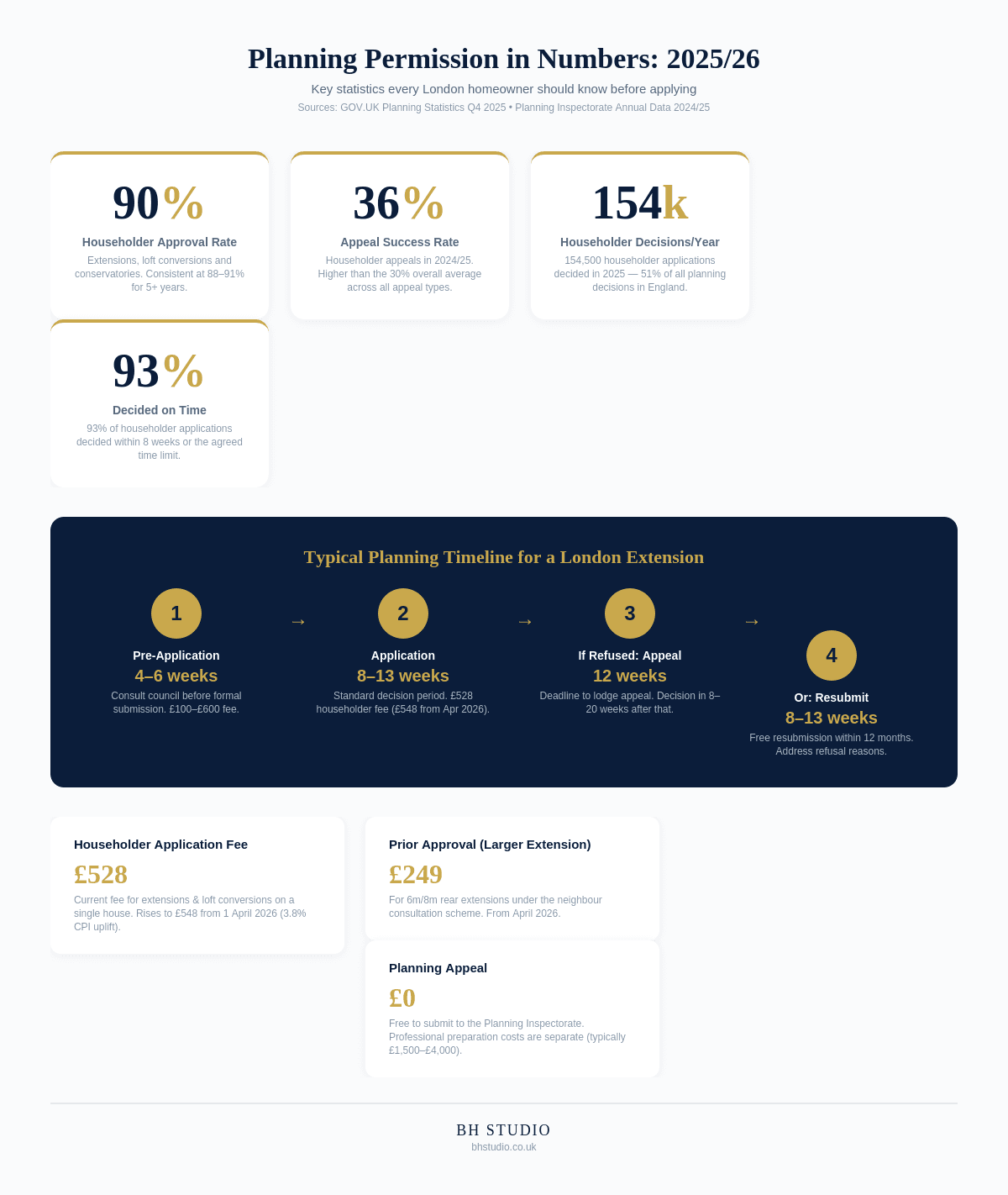
The good news is that the system isn't stacked against homeowners. Government statistics for the quarter ending December 2025 show that local authorities across England granted 90% of householder planning applications - a category that includes extensions, loft conversions, and conservatories. That approval rate has remained remarkably stable over the past five years, sitting consistently between 88% and 91%.
The 10% that are refused tend to share common characteristics. Planning officers assess every application against two key frameworks: the National Planning Policy Framework (NPPF), which sets out the government's planning priorities for England, and their borough's Local Plan, which translates national policy into area-specific rules. When an application conflicts with either of these, the case officer will recommend refusal - and the decision notice will cite the specific policies that the proposal breaches.
Understanding those policies before you submit is the difference between a straightforward approval and months of delays, redesigns, and additional costs. A householder planning application in England currently costs £528, rising to £548 from April 2026. That's money you'd rather not spend twice.
The 8 Most Common Refusal Reasons for Extensions and Loft Conversions in London
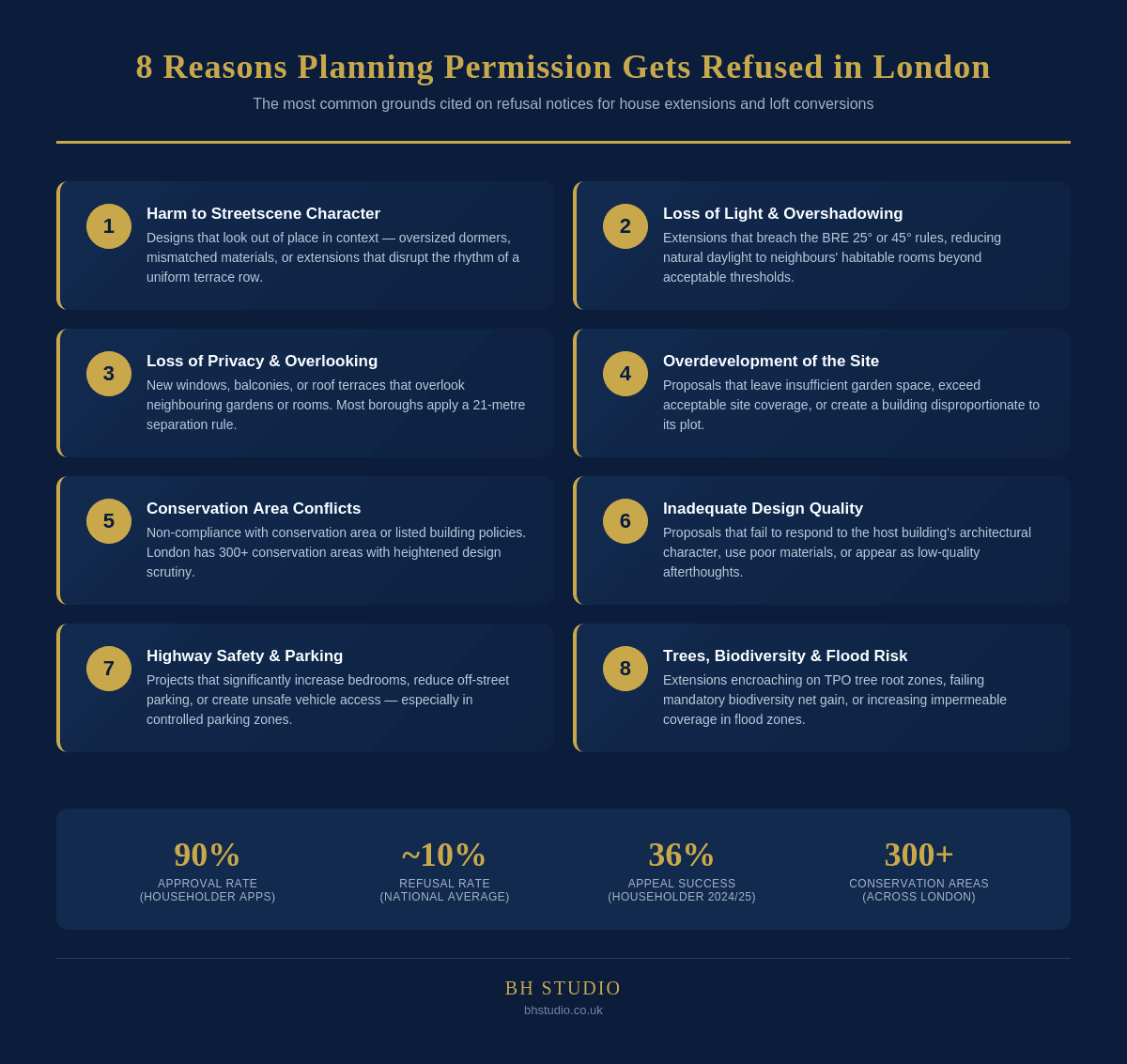
Planning refusals are never arbitrary. Every decision notice must cite specific policy reasons. Here are the eight grounds that appear most frequently on refusal notices for residential extensions and loft conversions in London - and what each one actually means for your project.
1. Harm to the Character and Appearance of the Streetscene
This is the most commonly cited refusal reason across all London boroughs. Planning officers assess whether your extension or loft conversion would look out of place in the context of neighbouring properties and the wider street. A dormer that's significantly larger than others on your terrace, materials that clash with the existing building, or a side extension that disrupts the rhythm of a uniform Victorian row - all of these can trigger a refusal on character grounds.
London's streets have strong visual identities. In Hackney's Victorian terraces, Islington's Georgian crescents, and Muswell Hill's Edwardian avenues, councils are protective of that character. What matters is context: the same rear dormer that's perfectly acceptable on one street might be refused on another because of differences in the established roofline pattern.
2. Loss of Light and Overshadowing
Councils use a technical assessment - typically the BRE (Building Research Establishment) guidelines for daylight and sunlight - to evaluate whether your extension will unacceptably reduce natural light to neighbouring properties. The 25-degree rule and the 45-degree rule are the most commonly applied tests. If your extension breaches these angles from a neighbour's habitable room window, you're very likely to face a refusal.
This is particularly relevant for two-storey rear extensions and side return extensions on terraced houses in London, where properties are closely packed and gardens are short. Even a single-storey extension can cause overshadowing issues if it's close to a boundary and your neighbour's windows are positioned low on the party wall.
3. Loss of Privacy and Overlooking
New windows, balconies, and roof terraces that overlook a neighbour's garden or habitable rooms are a frequent trigger for refusal. Most London boroughs apply a 21-metre rule - meaning windows in habitable rooms should maintain at least 21 metres of separation from facing windows in neighbouring properties. For oblique angles, this typically reduces to around 12 metres.
Loft conversions are especially vulnerable to this issue. Side-facing dormer windows overlooking adjacent properties will almost always be required to use obscured glass and be non-opening below 1.7 metres from the internal floor level. Failing to include these measures in your drawings is one of the most easily avoidable causes of refusal.
4. Overdevelopment of the Site
Every property has a finite capacity for extension. When a proposal - either alone or combined with previous extensions - tips the balance so that the building dominates its plot, planning officers describe it as "overdevelopment." This typically manifests as insufficient remaining garden space, an unacceptably high site coverage ratio, or a building that appears disproportionate in its surroundings.
London's tight plots make overdevelopment a common issue. A Victorian terrace in Walthamstow with a 10-metre garden that already has a 3-metre extension will face serious questions if the homeowner then proposes a further 3-metre rear extension. Many boroughs require at least 50% of the original garden to remain as usable outdoor space - a threshold that's easy to breach on London's characteristically narrow sites.
5. Non-Compliance with Conservation Area or Listed Building Policies
London has over 300 designated conservation areas across its 33 boroughs. If your property falls within one, the permitted development rights that would normally allow many extensions and loft conversions without planning permission may be restricted or removed entirely. Applications in conservation areas face heightened scrutiny: materials must match the existing building, designs must preserve the area's special character, and front-facing alterations are almost always refused.
Listed building consent is a separate requirement on top of planning permission. Any works - internal or external - that affect the character of a listed building require this additional approval. Islington, with its 27 conservation areas and numerous listed buildings, is one of the most challenging boroughs for homeowners seeking to extend or convert their loft without specialist guidance.
6. Inadequate Design Quality
Planning officers increasingly expect extensions and loft conversions to demonstrate genuine design thought - not just compliance with technical parameters. The London Plan, which sits above individual borough local plans, emphasises "good design" as a material planning consideration. Proposals that appear as afterthoughts, use poor-quality materials, or fail to respond to the architectural language of the host building can be refused on design quality alone.
This is where many homeowner-designed or template-based applications fall short. A loft conversion designed by someone who understands both the planning context and the architectural character of your property type is far more likely to succeed than one drawn up from a generic template. This is a core advantage of working with a design-and-build firm that handles both the creative and the regulatory sides of the process.
7. Impact on Highway Safety or Parking
While less common for straightforward domestic extensions, transport-related objections can arise when a project significantly increases the number of bedrooms (which councils use as a proxy for increased car ownership) or reduces existing off-street parking. Extensions that create a new vehicular access onto a classified road, or that reduce visibility at a junction, will face transport-related objections.
In boroughs with controlled parking zones - which covers most of inner London - the loss of a garage or driveway space through a side extension can also trigger concerns, particularly if the area already experiences parking pressure.
8. Harm to Trees, Biodiversity, or Flood Risk
Tree preservation orders (TPOs) protect individual trees and groups of trees from removal or significant pruning. Extensions that encroach on the root protection area of a TPO tree, or that would require the removal of mature trees contributing to the area's character, will face objections from the council's tree officer. London's urban canopy is a priority across all boroughs, and proposals that reduce it without adequate justification or replacement planting are routinely refused.
Since the introduction of mandatory biodiversity net gain in February 2024, even small householder developments must demonstrate that they will not reduce biodiversity on the site. Flood risk is another consideration: extensions that increase impermeable surface coverage on sites in flood zones 2 or 3 need a flood risk assessment, and proposals without one will be refused.
Extension-Specific Refusal Triggers in London
House extensions in London face a distinct set of planning challenges shaped by the capital's dense housing stock and strict borough-level policies. Understanding these before you submit can save months of delay.
Rear Extensions: Depth and Boundary Proximity
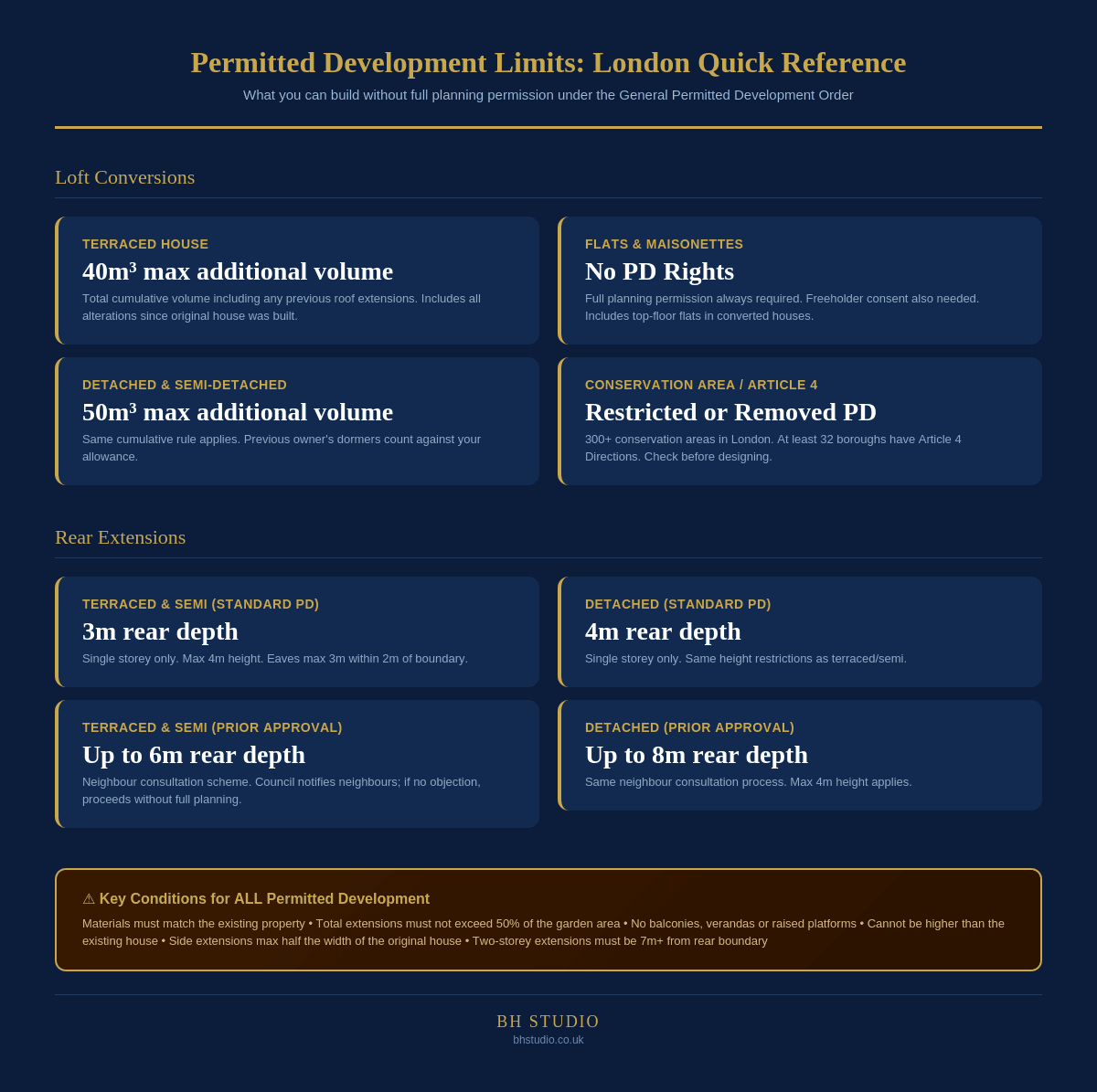
Under permitted development, terraced and semi-detached houses can extend up to 3 metres to the rear without planning permission (or up to 6 metres under the larger home extension scheme with prior approval). Detached houses can go to 4 metres, or 8 metres with prior approval. Once you exceed these limits, you need full planning permission - and the further beyond the permitted development envelope you go, the harder it becomes to get approval.
Rear extensions that push too close to boundaries create overshadowing issues. Most London boroughs apply a 45-degree line drawn from the nearest first-floor window of a neighbouring property. If your extension's roof breaches this line, you'll face a refusal on loss-of-light grounds. For terraced properties in areas like Hackney and Islington, where rear elevations face directly onto neighbouring gardens at close range, this constraint can limit your extension depth significantly.
Side Return Extensions: The Half-Width Rule
Side return extensions are enormously popular on London's Victorian terraced houses, which often have a narrow passage running along one side. Under permitted development, a side extension cannot exceed half the width of the original house. Proposals that breach this rule - or that extend further than the rear wall - require planning permission and face scrutiny on grounds of overdevelopment, impact on the streetscene, and potential to set a precedent for neighbouring properties.
Two-Storey Extensions: Heightened Scrutiny
Two-storey rear extensions must not extend more than 3 metres beyond the rear wall of the original house under permitted development, and must be at least 7 metres from any rear boundary. In practice, many London gardens are too short to meet this requirement, pushing homeowners into the full planning application route. Two-storey proposals face the same loss-of-light and overlooking assessments as single-storey extensions, but at greater intensity - the taller the structure, the greater the potential for harm to neighbours.
Wraparound Extensions: The Most Complex Route
Combining a rear extension with a side return to create a wraparound layout almost always requires full planning permission. These proposals are assessed holistically: their total footprint, visual impact from both the rear and side elevations, and cumulative effect on garden space. In boroughs like Waltham Forest and Haringey, where many properties have already been extended, cumulative impact is a particular concern.
Loft Conversion Planning Pitfalls in London
Most loft conversions on houses - as opposed to flats - can proceed under permitted development rights without full planning permission, provided they stay within the strict limits set by the General Permitted Development Order. But London's unique characteristics push many conversions outside those limits, and into the full planning application process.
Volume Limits: 40m³ and 50m³
Terraced houses are allowed up to 40 cubic metres of additional roof space under permitted development. Detached and semi-detached houses get 50 cubic metres. Crucially, this is the total volume ever added - if a previous owner installed a dormer 20 years ago, that volume counts against your allowance. Many London homeowners are caught out by previous alterations they didn't know about when they purchased the property.
Exceeding these volume limits by even a small margin means full planning permission is required. And because you're now outside permitted development, the council has full discretion to refuse - there's no automatic right to the additional space.
Mansard Conversions: Almost Always Need Planning
Mansard loft conversions - which raise the party wall and create a near-vertical rear roof slope - change the overall height and profile of the building. This takes them outside permitted development in virtually every case. In boroughs like Islington, where conservation area rules dominate and mansard is often the only conversion type that officers will support, you face the paradox of needing to apply for planning permission for the very design that the council prefers.
Success with a mansard application depends on demonstrating that the design matches the prevailing roofscape. If neighbouring properties already have mansard conversions, yours is far more likely to be approved. If yours would be the first, expect significantly more scrutiny.
Front-Facing Dormers: A Near-Automatic Refusal
Under permitted development, roof extensions must not project beyond the existing roof plane on the principal elevation facing the highway. In simple terms: no front-facing dormers under permitted development. If you apply for full planning permission for a front dormer, the bar is extremely high. Unless your street already has a consistent pattern of front dormers, councils in London will almost always refuse on grounds of visual harm to the streetscene.
Flats and Maisonettes: No PD Rights
Permitted development rights for loft conversions apply only to houses. If you live in a flat or maisonette - even the top-floor flat of a converted Victorian house - full planning permission is mandatory. You'll also need the freeholder's consent and potentially listed building consent if the building is listed. London's large stock of converted period properties means this catches more homeowners than you might expect.
Conservation Areas and Article 4 Directions: London's Strictest Planning Zones
If there's one factor that trips up London homeowners more than any other, it's failing to check whether their property falls within a conservation area or an Article 4 Direction zone before designing their extension or loft conversion.
London has over 300 conservation areas - from Hackney's Chatsworth Road and Clapton Square to Islington's Barnsbury, Canonbury, and Highbury Fields, to Muswell Hill's Edwardian town centre. Within these areas, permitted development rights are significantly restricted. Roof extensions that add to the volume of the roof on any elevation facing the highway are not permitted development, and many other alterations that would normally proceed without planning permission require a full application.
Article 4 Directions go further. A borough can issue an Article 4 Direction to remove specific permitted development rights in a defined area - even rights that would normally be available outside conservation areas. At least 32 London boroughs have Article 4 Directions in place in some form, covering everything from loft conversions to replacement windows. The practical effect is that works that your neighbour two streets away can do without permission may require a full application on your street.
Before you spend anything on design, check your council's interactive planning map to confirm whether your property sits within a conservation area or Article 4 zone. This single step takes five minutes and can save thousands of pounds in abortive design fees.
Neighbour Objections: What Counts and What Doesn't
Neighbour objections are one of the most misunderstood aspects of planning. When you submit a planning application, the council notifies adjoining occupiers and invites comments. These comments are a "material consideration" - the council must take them into account - but they are not a veto. A planning officer cannot refuse your application simply because neighbours oppose it.
What matters is whether the objections raise legitimate planning concerns. Loss of light, overlooking, noise from construction, and impact on the character of the area are all valid planning matters. But the following are not valid grounds for refusal, regardless of how strongly neighbours feel about them:
Loss of a private view is not a planning consideration. Neither is the potential impact on a neighbour's property value, construction noise during the build (which is a separate environmental health matter), the identity or lifestyle of the applicant, or general opposition without specific planning grounds. A council that refuses an application based solely on the volume of objections, without identifying a specific policy breach, would lose on appeal.
The smartest approach is proactive neighbour engagement. Before you submit, show your neighbours the plans. Explain the project. Address their concerns in the design where possible. A party wall surveyor - required for most loft conversions and many extensions on terraced properties - should be instructed at least two months before works begin, and early engagement with neighbours can smooth this process significantly.
What to Do After a Planning Refusal
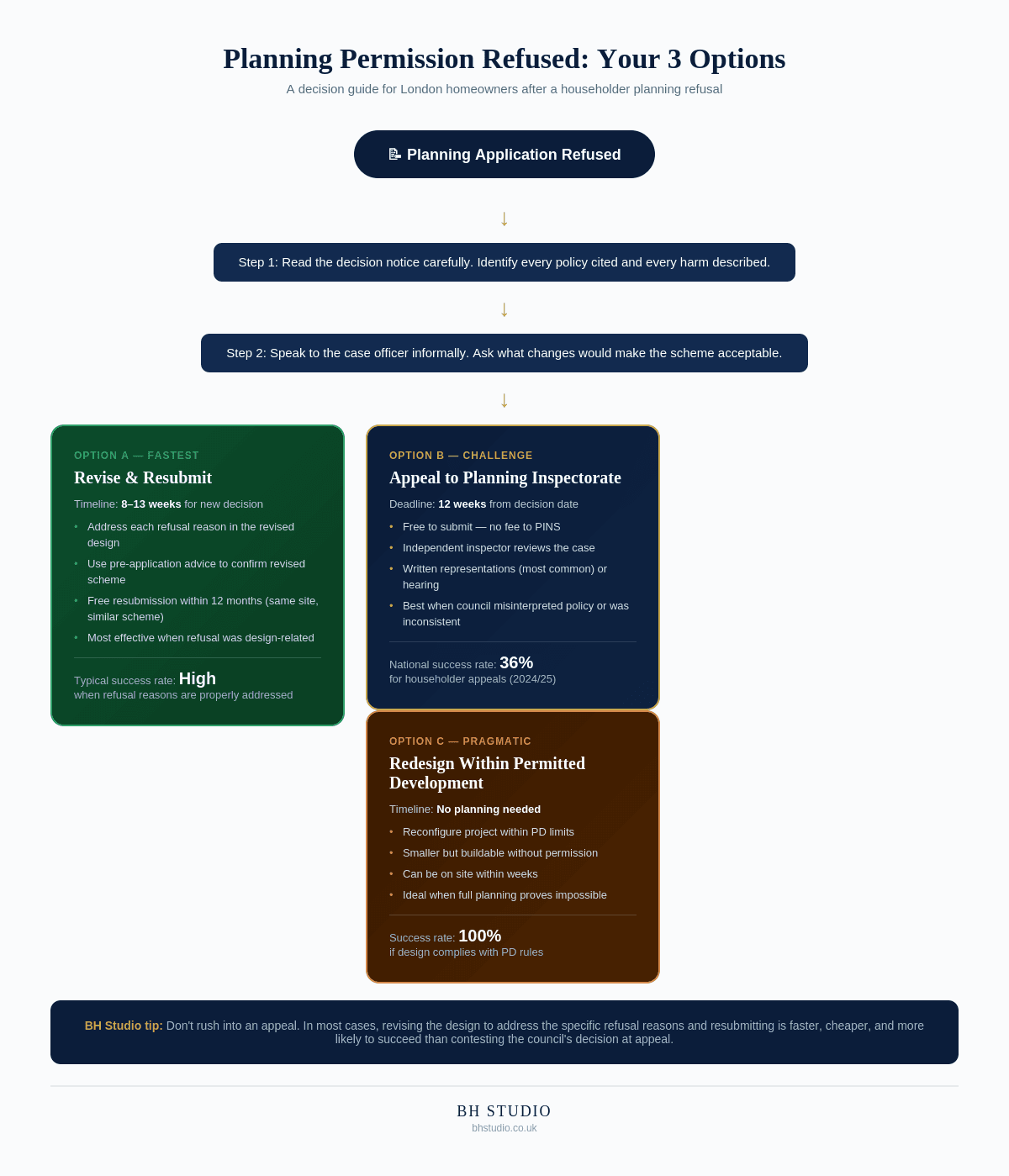
A planning refusal isn't a permanent "no." It's a decision based on specific policy reasons - and once you understand those reasons, you can decide the best path forward. You have three main options.
The first and often fastest route is to revise and resubmit. If the reasons for refusal are design-related - the extension is too deep, the dormer is too large, the materials don't match - you can address those issues and submit a fresh application. Many councils offer a free or reduced-fee resubmission if you apply within 12 months of the refusal, provided the application is for the same site and is of similar character.
The second option is to appeal to the Planning Inspectorate. This is appropriate when you believe the council has misinterpreted policy, applied it inconsistently, or made errors of fact. Householder appeals must be submitted within 12 weeks of the decision date. The appeal is determined by an independent inspector who was not involved in the original decision.
The third option is to redesign within permitted development limits. If full planning permission for your original scheme is proving too difficult, an experienced designer may be able to reconfigure the project to fall within permitted development rights - bypassing the planning system entirely. This often means a smaller scheme, but it can be the pragmatic choice when speed matters.
The Planning Appeal Process Explained
If you decide to appeal, here's what the process looks like in practice. The appeal is free to submit - there's no fee payable to the Planning Inspectorate - but you'll likely need professional help to prepare a strong case, which carries its own costs.
Deadlines and Timescales
For householder applications (which covers most extensions and loft conversions), the appeal must be lodged within 12 weeks of the date on the decision notice. For other types of planning application, the deadline is 6 months. Miss these deadlines and your right to appeal is lost - you'd need to submit a fresh application instead.
Most householder appeals are decided through the written representations procedure, which means no hearing or inquiry - just written statements from both sides. The Planning Inspectorate aims to decide written representation appeals within 8 to 14 weeks of receiving all the documentation, though backlogs can extend this. As of early 2026, around 42% of written representation appeals were decided within 20 weeks.
How Appeals Are Decided
The inspector considers the council's reasons for refusal, your appeal statement, any supporting documents, and the representations from interested parties. They visit the site and assess the proposal against the development plan (the borough's local plan and the London Plan) and national policy.
Nationally, around 36% of householder appeals were successful in 2024/25, according to Planning Inspectorate statistics. That's higher than the overall appeal success rate of around 30%, reflecting the fact that councils sometimes refuse householder applications on marginal grounds that don't withstand independent scrutiny.
When an Appeal Is Worth Pursuing
An appeal is strongest when the council's reasons for refusal are subjective (design character judgments), inconsistent (similar schemes approved elsewhere on the same street), or based on policies that the inspector may weigh differently. Appeals are weakest when the refusal is based on clear, measurable breaches - such as a demonstrable loss of light that exceeds BRE guidelines, or a roof extension that exceeds the permitted development volume limit.
It's worth noting a significant upcoming change: the Planning Inspectorate has confirmed that from late 2026, appeals will be assessed solely on the evidence submitted during the original planning application. No new evidence or reports will be accepted at appeal stage. This makes it more important than ever to submit a complete, well-evidenced application from the outset.
Revise and Resubmit: Often the Fastest Route to Approval
For most homeowners, revising the scheme to address the council's specific concerns and resubmitting is faster, cheaper, and less stressful than an appeal. Here's how to make a resubmission count.
Start by reading the decision notice carefully. Every refusal lists the specific policies that the proposal breaches and the specific harms the council has identified. These are your roadmap for revision. If the refusal cites "unacceptable loss of daylight to the rear habitable room of No. 42," your revised scheme needs to demonstrate - with a daylight and sunlight assessment if necessary - that the redesigned extension doesn't breach the BRE guidelines at that specific point.
Contact the case officer. Most planning officers are willing to discuss a refusal informally and indicate what changes would make the scheme acceptable. This informal dialogue can save you from guessing and submitting a revision that still doesn't address the core issue.
Consider a formal pre-application meeting before resubmitting. For £100–£600 depending on the borough, you can present your revised scheme to a planning officer and get written feedback before committing to a full application. This is the most reliable way to confirm that your revised design will succeed.
Resubmissions within 12 months of a refusal benefit from the "free go" concession - you won't pay the full application fee again, provided the resubmission is for a similar scheme on the same site. Given that the householder fee is now £528 (rising to £548 from April 2026), this is a meaningful saving.
The Permitted Development Fallback
If full planning permission is proving impossible - perhaps the council has refused twice and an appeal has been dismissed - permitted development rights offer a fallback route that bypasses the planning system entirely.
Under permitted development, most houses (excluding flats, listed buildings, and some properties in conservation areas or Article 4 zones) can carry out specified extensions and loft conversions without submitting a planning application. The key limits for common London projects are as follows.
For single-storey rear extensions, the limit is 3 metres from the original rear wall for terraced and semi-detached houses, or 4 metres for detached houses. Under the larger home extension prior approval scheme, these increase to 6 metres and 8 metres respectively - subject to notifying the council and receiving confirmation that no objection has been raised by neighbours.
For loft conversions, the limit is 40 cubic metres of additional roof space for terraced houses, and 50 cubic metres for detached and semi-detached houses. The conversion must use materials matching the existing property, must not extend beyond the existing roof plane on the principal elevation, and must not include any side-facing windows unless they use obscured glass and are non-opening below 1.7 metres.
An experienced designer can often reconfigure a refused scheme to sit within these limits. The result may be smaller than the original proposal, but it can be built without any planning permission - and can often be on site within weeks rather than months.
How to Avoid a Planning Refusal in the First Place
Prevention is always better than cure. Here are the most effective strategies for getting your extension or loft conversion approved first time.
Research Your Borough's Planning Policies
Every London borough publishes a Local Plan and supplementary planning documents that set out their expectations for residential extensions. Some boroughs - Islington, Camden, and Hackney among them - publish detailed residential design guides that specify exactly what they expect in terms of extension depth, loft conversion type, materials, and fenestration. Read these documents before commissioning any design work. They're freely available on your council's website.
Study What's Been Approved (and Refused) Nearby
Every council's planning register is searchable online. Look at applications for properties on your street and surrounding streets. What types of extension have been approved? What has been refused? Planning decisions create precedents - if the council approved a rear dormer on your neighbour's identical terrace, they'll find it much harder to refuse the same thing on yours, all other factors being equal.
Invest in Professional Design
The quality of your submitted drawings and supporting documents directly affects your chances of approval. Applications with measured surveys, detailed floor plans, accurate elevation drawings, and a well-written design and access statement are treated more seriously by planning officers - and they're far less likely to contain the errors and omissions that lead to avoidable refusals.
Address Potential Objections in the Application
If your extension will be visible from a neighbour's window, include a sunlight and daylight assessment. If you're in a conservation area, include a heritage impact statement. If there are trees on or near the boundary, include a tree survey. Proactively addressing potential objections in your application demonstrates to the planning officer that you've considered the impact of your proposal - and it removes the grounds on which they might otherwise recommend refusal.
Pre-Application Advice: Your Single Best Investment
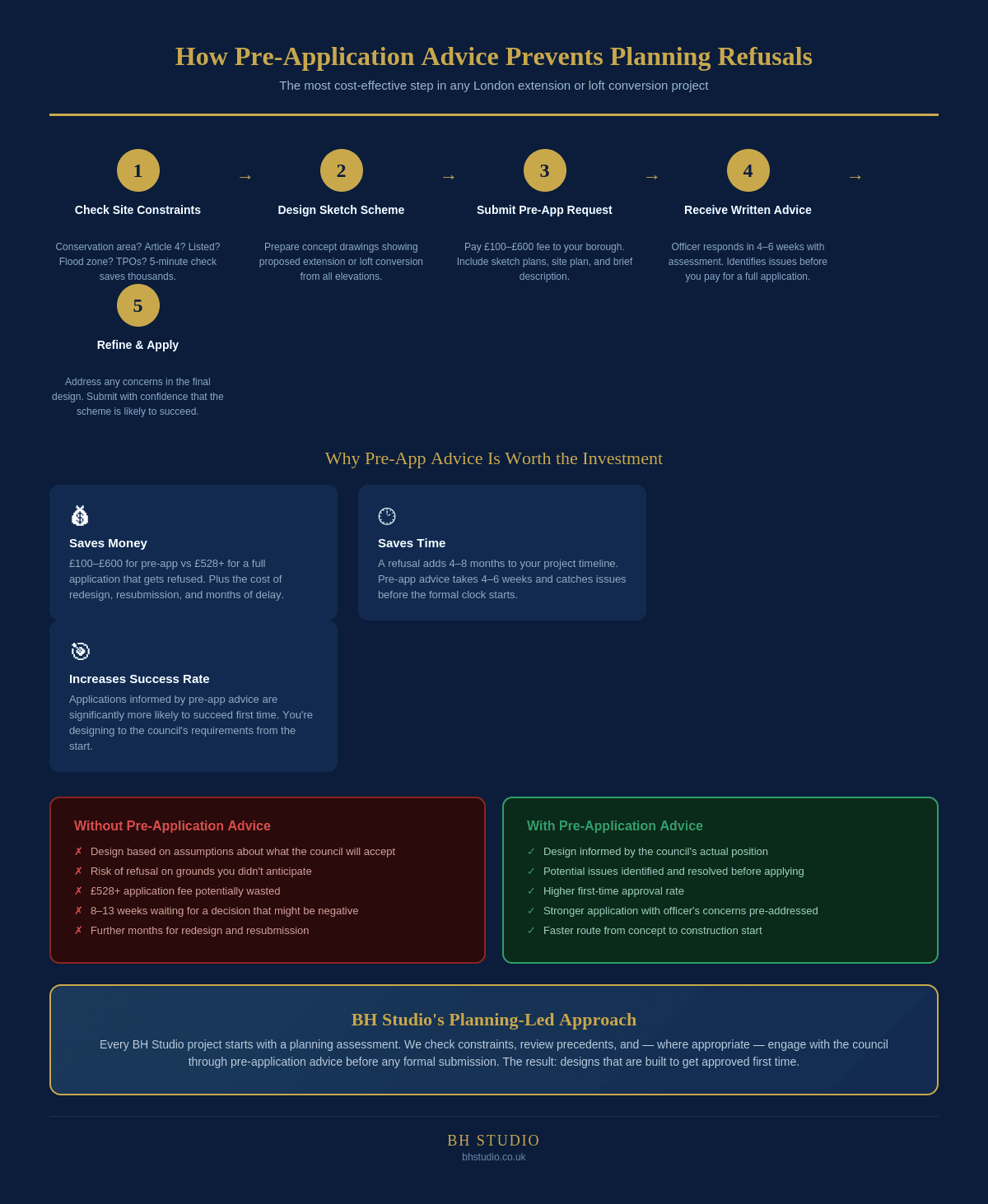
Almost every London borough offers a pre-application advice service. For a fee - typically £100 to £600 for householder proposals - you can present your draft scheme to a planning officer and receive a written assessment of its likely success before you commit to a full application.
Pre-application advice isn't binding - a positive pre-app response doesn't guarantee approval - but it gives you an informed view of the council's position and an opportunity to refine the design before the formal clock starts ticking. It's particularly valuable for properties in conservation areas, on complex sites, or where previous applications have been refused.
The most effective pre-application submissions include sketch drawings showing the proposed extension or loft conversion from all relevant angles, a brief written description of the proposal, and any supporting information that addresses likely concerns (heritage context, daylight analysis, tree survey). The more complete your submission, the more useful the officer's feedback will be.
For a Better Homes project, your architect advises whether pre-application engagement would be useful and prepares any agreed planning work. We can work with your own architect or introduce one we recommend. With managed support, we coordinate discussions and contribute construction cost and buildability advice while the proposal develops.
Why Design-and-Build Firms Get More Approvals
The traditional route for a home extension or loft conversion in London involves hiring an architect to produce planning drawings, submitting the application, and then - if approved - finding a builder to actually construct it. This fragmented approach creates a gap between what gets planned and what gets built, and it often leads to designs that look good on paper but don't account for the practical realities of construction in London.
A design-and-build firm manages the entire process - from initial concept and planning strategy through to construction and completion. This integrated approach has a direct impact on planning outcomes because the design team understands what can realistically be built, what will cost what, and how to present a proposal that addresses the council's concerns at the first attempt.
At Better Homes, design and build is a managed service: your architect prepares the drawings and agreed submissions, and we carry out the construction. Bring your own architect or choose one we recommend. With either route, you can ask us to coordinate discussions, follow up questions and speak on your behalf with your agreement. You approve the design, budget and changes; the proposal identifies the coordination support, appointments and fees.
Bring your architect or choose an independent architect we recommend. We manage construction, with agreed coordination support. Our workmanship guarantee covers structural work, extensions and loft conversions for 10 years, bathroom and kitchen installations for 2 years, and decoration for 1 year. Item breakages are excluded from our workmanship guarantee and fall under the manufacturers’ own guarantees. Insurance cover up to £10 million. Ask for current certificates and the cover applicable to your project.
Quick Takeaways
- Most refusals are fixable: 90% of householder applications are approved nationally. If yours was refused, it likely means a specific design issue needs addressing - not that your project is impossible.
- Read the decision notice word by word: The refusal reasons are your revision roadmap. Every cited policy and identified harm tells you exactly what to change.
- The 12-week appeal clock is real: If you want to appeal a householder refusal, you must lodge it within 12 weeks. Start gathering evidence immediately, even while considering other options.
- Pre-app advice is cheap insurance: At £100–£600, a pre-application consultation costs less than 10% of the typical full application investment and dramatically reduces the risk of refusal.
- Conservation areas change everything: Over 300 conservation areas across London restrict permitted development rights. Check before you design - not after you've paid for drawings.
- Neighbour objections aren't a veto: The council can only refuse on legitimate planning grounds. Loss of view and property value concerns are not valid refusal reasons.
- Permitted development is your safety net: If planning permission proves impossible, an experienced designer can often reconfigure your project within PD limits - no application needed.
A Planning Refusal Is a Setback, Not a Dead End
Having your planning permission refused is frustrating, but it's far from the end of the road. The vast majority of London homeowners who receive a refusal can still achieve their extension or loft conversion - whether by revising the design, appealing to the Planning Inspectorate, or reconfiguring the project within permitted development limits.
The key is understanding why the refusal happened and responding strategically. Read the decision notice, speak to the case officer, research what's been approved on comparable properties, and consider pre-application advice before resubmitting. And if you haven't yet applied, invest the time upfront to get the design right - a well-prepared application with professional drawings and a solid planning strategy is your best defence against refusal.
At Better Homes, your own or a recommended architect advises on planning and prepares the agreed drawings; we build. If you want managed support, we organise discussions, follow up questions and contribute construction cost and buildability advice. You approve design and budget decisions. We work across Central, East and North London, with the appointments and fees set out in your proposal.
If your planning application has been refused - or if you want to make sure your first application succeeds - get in touch for a free, no-obligation consultation. We'll review your site, assess the planning context, and give you an honest assessment of what's achievable.
Frequently Asked Questions
How long do I have to appeal a planning refusal in London?
For householder applications (which includes most extensions and loft conversions), you have 12 weeks from the date on the decision notice to lodge an appeal with the Planning Inspectorate. For other types of planning application, the deadline is 6 months. Missing these deadlines means losing your right to appeal that specific decision - you'd need to submit a fresh application instead.
What is the success rate for planning appeals on house extensions?
Nationally, around 36% of householder planning appeals were successful in 2024/25, according to Planning Inspectorate statistics. This is higher than the overall appeal success rate of approximately 30%. Success rates increase significantly when a professional planning consultant presents the case, particularly where the refusal involved subjective design judgments rather than clear, measurable policy breaches.
Can my neighbours block my planning application?
No. Neighbour objections are considered by the council, but they cannot veto a planning application. The council can only refuse permission on legitimate planning grounds - such as loss of light, overlooking, or harm to the streetscene. Objections based on loss of a private view, impact on property values, construction disruption, or the identity of the applicant are not valid planning reasons and cannot be used to justify a refusal.
Does my loft conversion need planning permission in London?
Most loft conversions on houses can proceed under permitted development rights without planning permission, provided they stay within specific volume limits (40m³ for terraced houses, 50m³ for detached and semi-detached) and meet other conditions such as matching materials and not projecting beyond the principal elevation roofline. However, flats and maisonettes always need planning permission, as do properties in conservation areas with Article 4 Directions, listed buildings, and conversions that exceed the PD limits.
How much does it cost to resubmit a planning application after refusal?
If you resubmit within 12 months of a refusal for a similar scheme on the same site, you may benefit from the "free go" concession - meaning you won't pay the full application fee again. The standard householder application fee is currently £528 in England, rising to £548 from April 2026. However, you'll still need to pay for any revised architectural drawings, supporting surveys, or professional advice required to address the refusal reasons.
What is an Article 4 Direction and how does it affect my extension?
An Article 4 Direction is an order made by a local authority that withdraws specific permitted development rights in a defined area. This means works that would normally not require planning permission - such as rear dormers, certain roof alterations, or changes to external materials - will need a full planning application in areas covered by the direction. At least 32 London boroughs have Article 4 Directions in some form. You can check whether your property is affected on your council's planning website.
Should I get pre-application advice before submitting my planning application?
Strongly recommended, especially for properties in conservation areas, on corner plots, or where previous applications have been refused. Pre-application advice from your London borough typically costs £100–£600 for householder proposals and provides a written assessment from a planning officer before you commit to a full application. While not binding, it significantly reduces the risk of refusal by flagging potential issues at a stage where they can be designed out at minimal cost.
Have You Dealt With a Planning Refusal?
We'd love to hear about your experience. Did you appeal, revise and resubmit, or take a different route? What advice would you give to other London homeowners facing the same situation? Share your story in the comments below or tag us on social media - your experience could help someone else navigate the process. And if you found this guide useful, please share it with friends and neighbours who might be planning an extension or loft conversion in London.
References
- GOV.UK - Planning Applications in England: October to December 2025
- Planning Inspectorate / Appeal Finder - Planning Appeal Success Rates and Timescales
- GOV.UK - Permitted Development Rights for Householders: Technical Guidance
- Planning Portal - Loft Conversion Planning Permission Guidance
- GOV.UK - Planning Fees: Annual Indexation from 1 April 2026