 Better Homes
House extension
Loft conversion vs house extension in London: which adds more value? (2026 guide)
London-focused comparison of loft conversions versus house extensions covering costs, ROI, planning permission, timelines, disruption, property types and move-vs-improve economics.
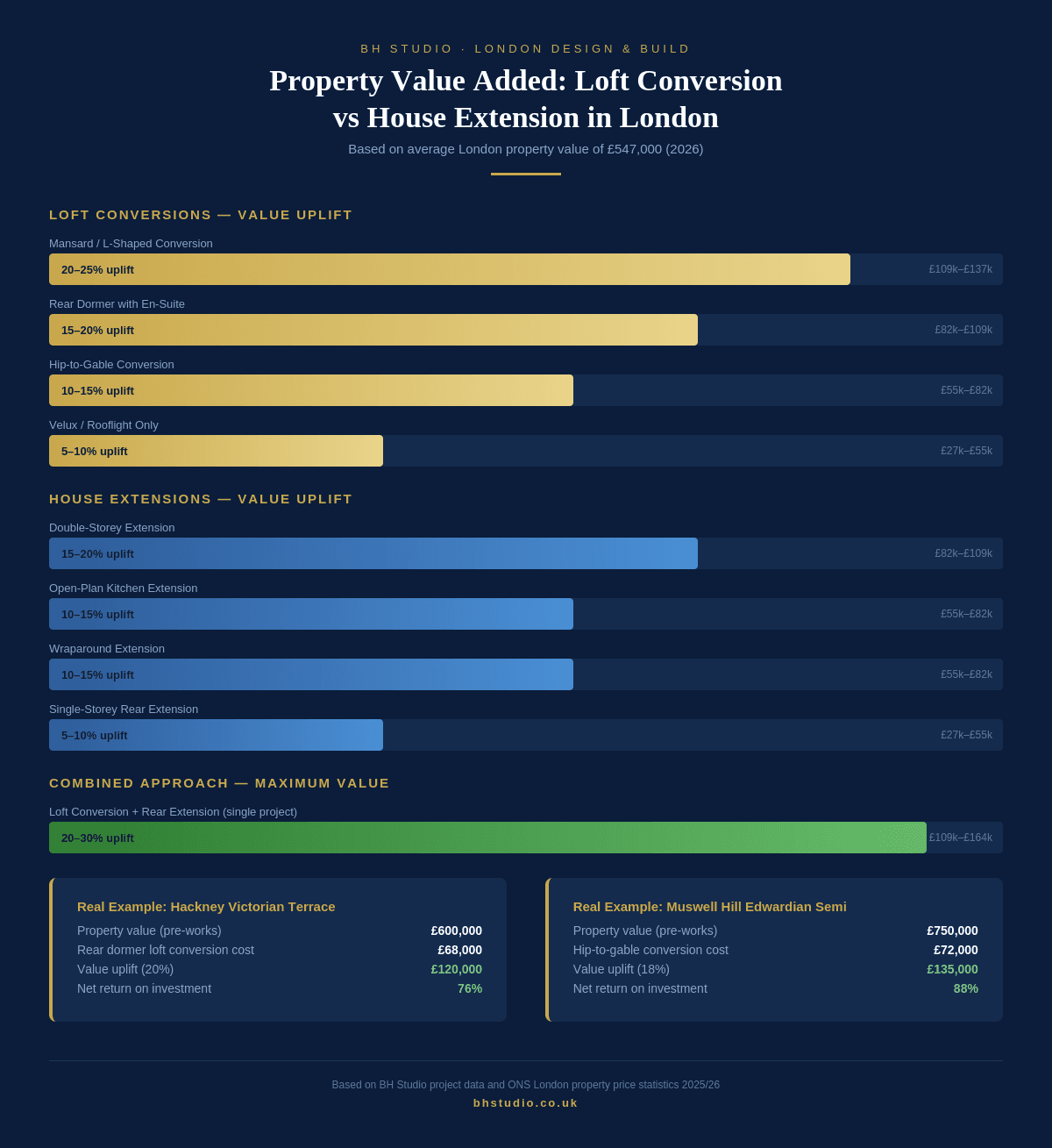
Loft Conversion vs House Extension in London: Which Adds More Value? (2026 Guide)
For most London homeowners, a loft conversion delivers a higher return on investment than a house extension. A rear dormer loft conversion costs £45,000–£75,000 and typically adds 15–25% to your property's value, while a single-storey rear extension costs £50,000–£85,000 and adds 5–10%. Loft conversions are also faster to build (6–12 weeks vs 10–24 weeks), less disruptive to daily life, and more likely to qualify for permitted development - meaning no planning permission is needed. However, if you need more ground-floor living space, such as an open-plan kitchen-diner, an extension is often the better choice. The right decision depends on your property type, budget, planning constraints, and what kind of space you actually need.
Key Takeaways
- Loft conversions typically cost 20–35% less than equivalent extensions and deliver stronger ROI per pound spent
- A dormer loft conversion in London adds 15–25% to property value; a single-storey extension adds 5–10%
- Most loft conversions qualify for permitted development - no planning permission needed
- Extensions take 2–3x longer to build and cause significantly more daily disruption
- Victorian terraces in Hackney, Islington, and Walthamstow are ideal candidates for loft conversions
- Moving house in London costs £50,000+ in fees alone - improving your home is almost always cheaper
- Combining a loft conversion and extension in a single project delivers the highest total value uplift (20–30%)
What This Guide Covers
What London Homeowners Need to Know Before Choosing
If you own a home in London and need more space, you've almost certainly asked yourself this question: should I convert the loft or build an extension? It's one of the biggest decisions a homeowner can make - not just financially, but in terms of how your home functions for years to come.
The answer isn't the same for everyone. A young family in a Victorian terrace in Hackney has different needs from a couple in an Edwardian semi in Muswell Hill. Your budget, your property's structure, your borough's planning rules, and what you actually need the space for all play a role.
What most guides get wrong is treating this as a simple either/or comparison. The reality is more nuanced. Some properties are perfect for a loft conversion but completely unsuitable for a rear extension. Others have the garden space for a stunning kitchen extension but a roof that doesn't have the height for a liveable loft. And for a growing number of London homeowners, the best answer is to do both in a single, well-managed project.
This guide draws on real project data from Better Homes' work across Central, East, and North London - not generic UK averages. We've included current 2026 costs, borough-specific planning considerations, and the kind of detailed ROI analysis that helps you make a genuinely informed decision. Whether you're comparing a dormer loft conversion with a rear extension, weighing up planning risks in Islington's conservation areas, or simply trying to work out which option gives you the best return per pound, you'll find the data here.
If you want the supporting detail behind specific parts of this decision, our complete loft conversions guide, loft planning permission guide, house extension value guide, and London renovation cost guide expand on costs, planning risk, and whole-home ROI.
Quick Comparison - Loft Conversion vs House Extension at a Glance
Before diving into the detail, here's a side-by-side comparison of the key factors. This table reflects London-specific pricing and timelines for 2026.
| Factor | Loft Conversion | House Extension |
|---|---|---|
| Typical London cost | £25,000–£100,000+ | £40,000–£150,000+ |
| Cost per m² | £1,800–£3,200 | £2,500–£3,500 |
| Value added | 15–25% | 5–20% |
| Build time | 6–14 weeks | 10–24 weeks |
| Total project time | 4–7 months | 5–10 months |
| Planning permission | Usually not needed | Often required |
| Garden space impact | None | Reduces garden |
| Disruption level | Low to moderate | Moderate to high |
| Best for | Bedrooms, offices, en-suites | Kitchens, living rooms, open-plan |
| Ideal property type | Terraced, semi-detached | All types with garden space |
The comparison reveals why loft conversions have become London's most popular home improvement. They're cheaper, faster, and for most terraced and semi-detached homes, deliver a stronger financial return. But extensions have their place - particularly when ground-floor space is what's lacking. Let's explore each factor in detail.
Cost Comparison - Which Is Cheaper in London?
Cost is usually the first question London homeowners ask, and the answer is clear: loft conversions are almost always cheaper than house extensions for a comparable amount of new space. London's construction costs run 15–25% higher than the national average due to labour rates, parking permits, scaffold licensing, and the logistical challenges of working in a dense urban environment - but these premiums apply equally to both options.
Loft Conversion Costs by Type (London 2026)
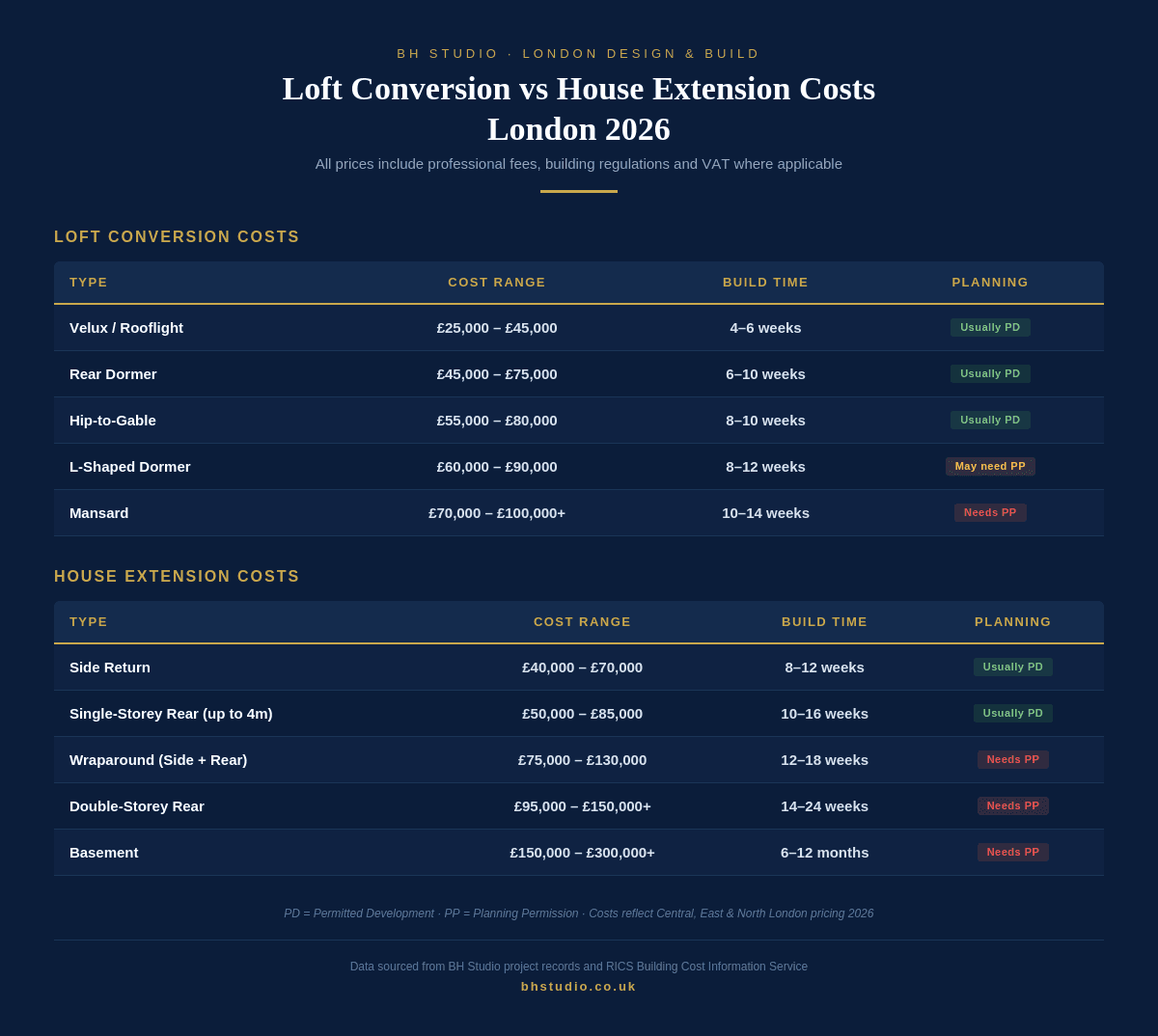
The cost of a loft conversion in London varies significantly depending on the type. A Velux or rooflight conversion, which uses the existing roof structure without extending it, is the most affordable option at £25,000–£45,000. This is ideal for properties with good ridge height where you simply need a room in the roof with skylight windows.
A rear dormer conversion - the most popular choice for London's Victorian terraces - costs £45,000–£75,000 and creates substantially more usable space by extending vertically from the rear roof slope. The L-shaped dormer, which wraps around the side of the rear addition, costs £60,000–£90,000 and maximises floor area. Hip-to-gable conversions, common in Edwardian semi-detached homes across Muswell Hill and Finchley, fall in the £55,000–£80,000 range. Mansard conversions, which alter the entire roof structure, are the most expensive at £70,000–£100,000+ and almost always require planning permission.
House Extension Costs by Type (London 2026)
Extensions have a wider cost range. A side return extension - very popular for Victorian terraces with a narrow alley alongside the kitchen - costs £40,000–£70,000 and can transform a galley kitchen into a bright, open cooking and dining space. A single-storey rear extension within permitted development limits (up to 3m for terraced, 4m for detached) runs £50,000–£85,000.
Larger projects climb steeply. A wraparound extension combining side and rear costs £75,000–£130,000. A double-storey rear extension, which adds both ground-floor and first-floor space, ranges from £95,000–£150,000+. And basement conversions - increasingly popular in high-value areas - start at £150,000 and can exceed £300,000 for a full dig-out.
Hidden Costs Most Guides Don't Mention
Beyond the headline build cost, several additional expenses catch London homeowners off guard. Party wall agreements, required when your works affect a shared wall with neighbours, cost £1,000–£3,000 and apply to most terraced house projects - whether loft or extension. Building regulations fees run £1,200–£2,500. A structural engineer's report costs £800–£1,500. And if you need planning permission, the householder application fee is £258 (as of 2026), though the architect's time preparing the application may add £1,000–£3,000 more.
Extensions carry some hidden costs that loft conversions avoid entirely. Foundation and groundwork costs can be unpredictable, particularly with London's variable clay soil. Temporary kitchen arrangements during a kitchen extension add £2,000–£5,000 to living costs. And scaffold licensing in London boroughs like Hackney and Islington, where parking is restricted, can add £500–£2,000 that many homeowners don't budget for.
Compare costs on the same basis. A construction quotation does not automatically include architect, engineer or surveyor fees. At Better Homes, the proposal identifies the professional appointments, fees and any managed coordination support you choose. That lets you see the wider project cost before committing, whether you bring your own architect or choose one we recommend.
Which Adds More Value to Your London Property?
For most London homeowners, the value question is what ultimately tips the decision. And the data is compelling: loft conversions consistently deliver a higher return on investment per pound spent than extensions. The reason is straightforward - adding a bedroom (especially one with an en-suite bathroom) is one of the most valuable improvements you can make to a London property, and a loft conversion achieves this at a lower cost than any other method.
Based on our project data and corroborated by industry sources, a dormer loft conversion that adds a bedroom and en-suite adds 15–25% to a London property's value. On a £600,000 terraced house in Hackney, that's £90,000–£150,000 of additional value from a £65,000–£75,000 investment. A mansard or L-shaped conversion can push even higher, adding 20–25% in boroughs with strong demand.
Extensions tell a different story. A single-storey rear extension typically adds 5–10% to property value. That's still meaningful - £30,000–£60,000 on a £600,000 home - but the investment required (£50,000–£85,000 for the build) leaves a thinner margin. Where extensions shine is the open-plan kitchen-diner configuration, which can push value uplift to 10–15% because it transforms the most-used room in the house.
Value by Borough - Where ROI Is Strongest
The return on investment varies significantly by location. In inner London boroughs like Hackney and Islington, where property values are high and space premiums are acute, loft conversions deliver the strongest percentage returns. A £75,000 dormer in Hackney on a £600,000 property can add approximately £120,000 in value - a return of roughly 60% on the conversion cost itself.
In North London areas like Muswell Hill and Crouch End, where Edwardian semi-detached houses dominate, hip-to-gable conversions offer excellent value. Average property values around £650,000–£750,000 mean even a conservative 18% uplift translates to £117,000–£135,000 of added value against a conversion cost of £65,000–£80,000. Walthamstow, with its lower average property values around £480,000, still delivers strong returns - particularly because competition for ranking on "loft conversion Walthamstow" is low, and the area's Victorian housing stock is ideally suited to dormer conversions.
When Extensions Win on Value
Extensions deliver better value than loft conversions in specific scenarios. If your property already has four or more bedrooms but lacks modern living space, a kitchen extension that creates an open-plan kitchen-diner will have a bigger impact on buyer appeal and price. Double-storey extensions, though expensive, can add 15–20% to property value because they create both ground-floor and first-floor space simultaneously. And in detached properties with large gardens, a wraparound extension often makes more architectural sense than a loft conversion, particularly if the existing roof has insufficient headroom.
Planning Permission - Which Is Easier to Get in London?
Planning permission is often the make-or-break factor for London homeowners, and loft conversions have a significant advantage here. Most loft conversions qualify for permitted development rights, meaning no planning application is needed - saving both time and money. Extensions, while sometimes falling under permitted development, are more likely to require a full planning application, particularly for larger projects.
Permitted Development for Loft Conversions
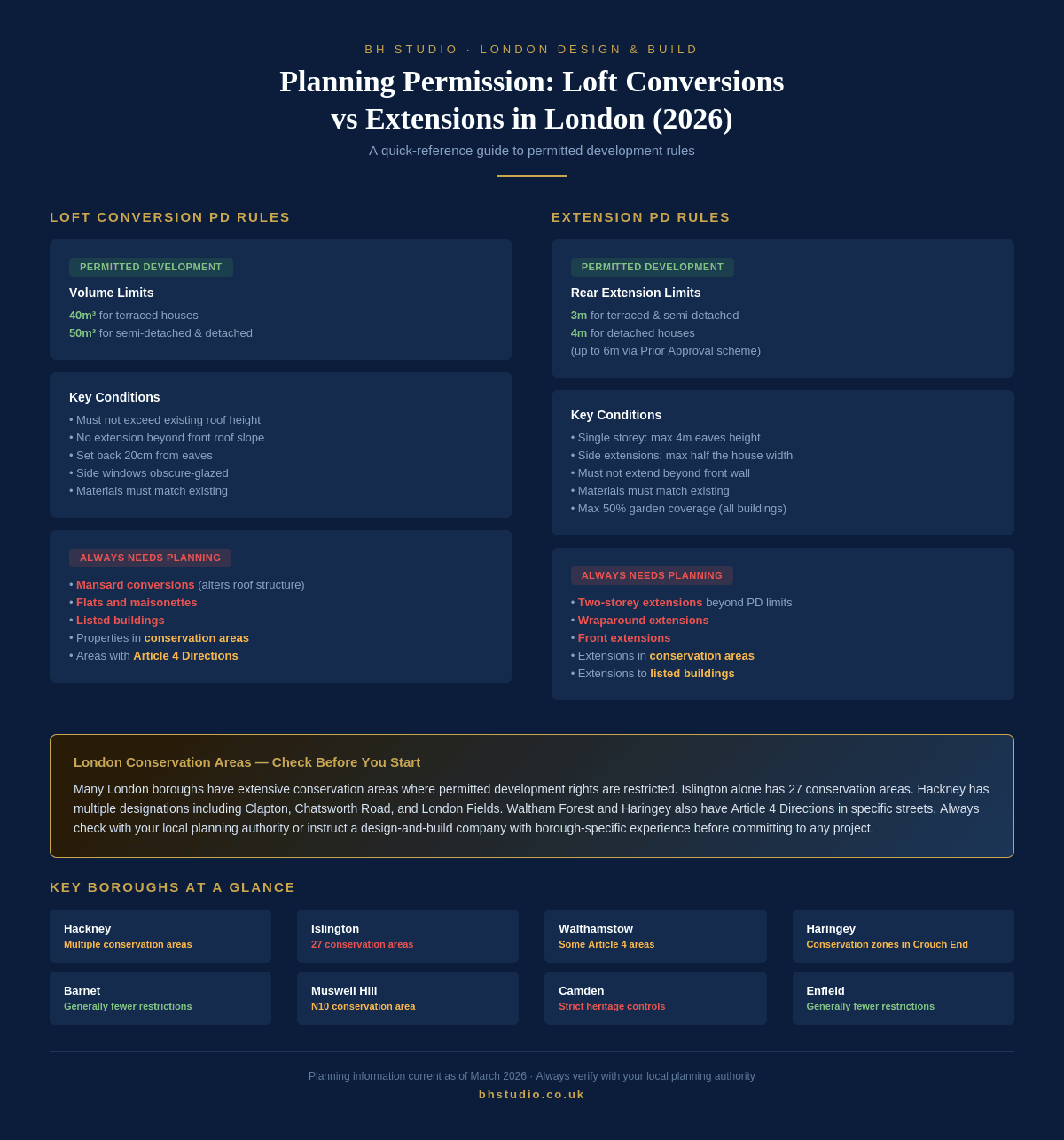
Under current rules, a loft conversion qualifies as permitted development if it meets these criteria: the additional volume doesn't exceed 40m³ for terraced houses or 50m³ for semi-detached and detached homes; the conversion doesn't extend beyond the existing roof slope on the front elevation; materials match the existing house; and side-facing windows are obscure-glazed. Rear dormer conversions, hip-to-gable conversions, and Velux conversions almost always fall within these limits.
Mansard conversions are the exception - they fundamentally alter the roof structure and almost always require planning permission. Properties in conservation areas, listed buildings, and areas subject to Article 4 Directions also fall outside permitted development rights.
Permitted Development for Extensions
Extensions have permitted development limits too, but they're more restrictive. Rear extensions can extend up to 3m from the original rear wall for terraced and semi-detached homes, or 4m for detached properties, without planning permission. The Prior Approval scheme allows up to 6m (terraced/semi) or 8m (detached), but requires a notification to your local authority and a 42-day waiting period.
Side extensions must not exceed half the width of the original house. Two-storey extensions have additional restrictions - they cannot extend beyond the rear wall by more than 3m and must be at least 7m from the rear boundary. Wraparound extensions that combine side and rear elements almost always require full planning permission.
Conservation Areas and Article 4 Directions
London has more conservation areas than any other region in the UK, and they significantly affect what you can build. Islington alone has 27 conservation areas, covering a large proportion of the borough. In these zones, permitted development rights are curtailed - you cannot add dormer windows or other roof extensions that would alter the appearance of the building from the principal elevation. Mansard conversions are the most commonly approved type in Islington's conservation areas because they're designed to blend with the existing Georgian and Victorian roofscape.
Hackney has conservation areas in Clapton, Chatsworth Road, Well Street, and London Fields. Waltham Forest has implemented Article 4 Directions in several streets, removing permitted development rights entirely. Before committing to any project, check your property's planning status with your local authority - or work with a design-and-build company that has experience navigating borough-specific rules. This is one area where local expertise makes a material difference to your project's feasibility and timeline.
Build Timeline - Which Is Faster?
If speed matters to you, loft conversions are the clear winner. A typical dormer loft conversion takes 6–10 weeks on site, with the full project timeline (including design, approvals, and procurement) running 4–7 months from first consultation to handover. Hip-to-gable and Velux conversions can be even quicker - some Velux conversions are completed in as little as 4–6 weeks.
Extensions take considerably longer. A single-storey rear extension typically requires 10–16 weeks of build time, with the full project timeline stretching to 5–8 months. Larger projects - wraparound or double-storey extensions - can take 14–24 weeks on site and 7–10 months overall. If planning permission is required, add another 8–13 weeks for the application and decision process. Basement extensions are in a category of their own, often taking 6–12 months of build time alone.
The timeline difference is partly structural. Loft conversions work with existing infrastructure - the roof, walls, and foundations are already in place. Extensions require new foundations, groundwork, drainage connections, and structural framing before any of the finishing work can begin. London's clay soil adds further unpredictability to foundation work, particularly during wet winters.
Disruption - Which Is Easier to Live Through?
This is a factor that many guides underplay, but anyone who has lived through a building project knows it matters enormously. Loft conversions are generally less disruptive because the work happens above the main living areas. Your kitchen, living room, and garden remain functional throughout the build. The main disruption comes during the staircase installation, which typically takes 2–3 days and temporarily affects the landing and hallway area.
Extensions are a different experience entirely. A kitchen extension means losing your kitchen for weeks - potentially months. You'll need a temporary cooking arrangement (many families set up a microwave and portable hob in the living room), and dust from construction can spread throughout the ground floor despite protective sheeting. Garden access is usually restricted during the build, and heavy machinery, skip deliveries, and scaffold erection create noise and disruption that affects the whole household.
From our experience managing projects across London, most families stay in their homes during a loft conversion without significant difficulty. For extensions - particularly kitchen extensions - we typically advise clients to prepare for 4–6 weeks of meaningful disruption to daily routines, and some choose to stay elsewhere for the noisiest phases of the build.
Which Suits Your Property Type?
Your property's architecture is one of the biggest determinants of which option makes sense. London's housing stock is wonderfully diverse, but certain property types are naturally better suited to one approach over the other. Here's what our experience across hundreds of London projects has taught us.
Victorian Terraces (Hackney, Islington, Walthamstow, Clapton)
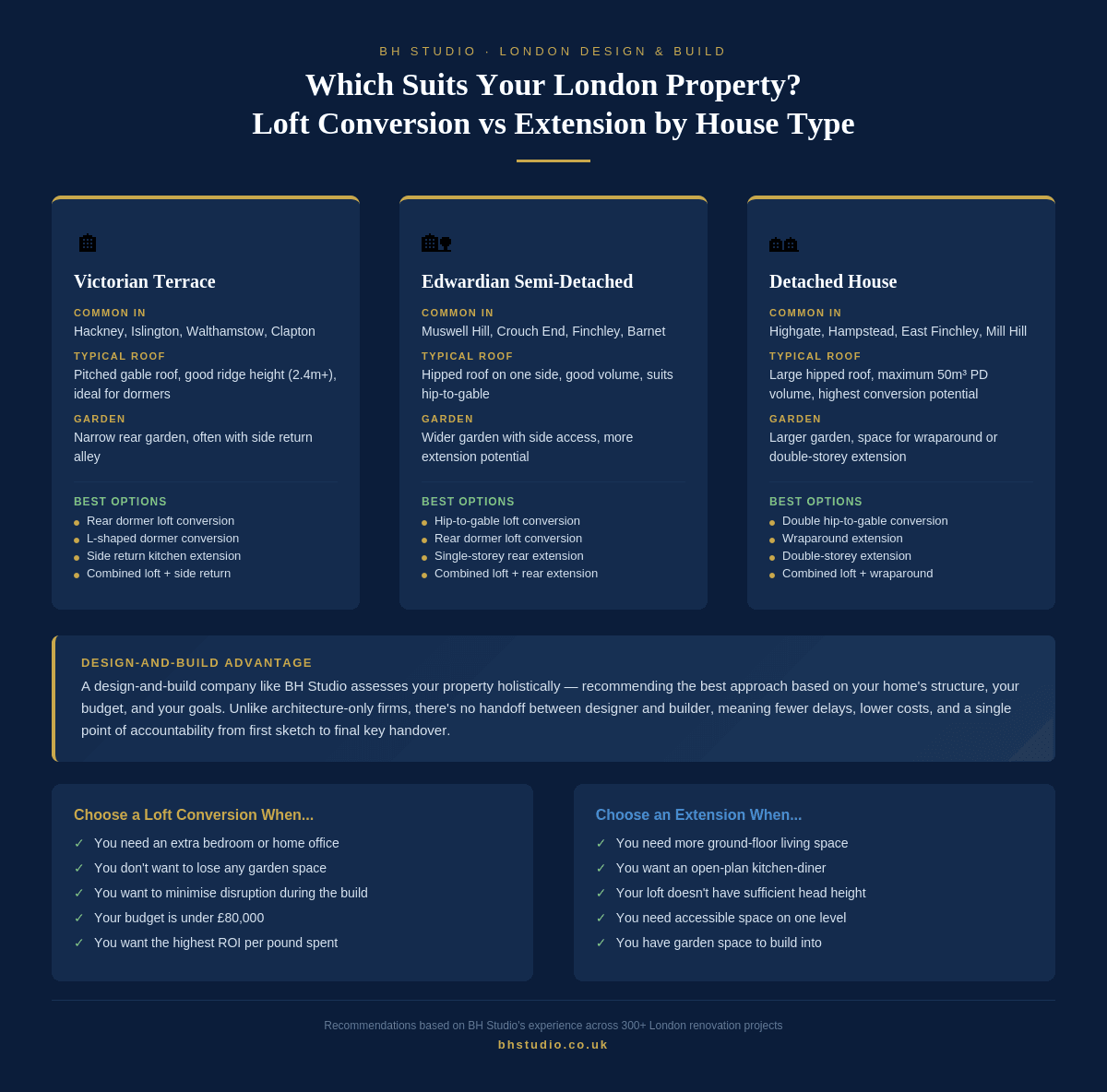
London's Victorian terraces are the sweet spot for loft conversions. These properties typically have pitched gable roofs with good ridge height (2.4m or more), making them ideal candidates for rear dormer or L-shaped dormer conversions. The vast majority qualify for permitted development, and the cost-to-value ratio is excellent - a £65,000 dormer on a £550,000 Walthamstow terrace adds roughly £110,000 in value.
Victorian terraces also suit side return extensions brilliantly. The narrow alley alongside the original kitchen can be incorporated into an enlarged kitchen-diner for £40,000–£70,000, transforming the ground floor. The most impactful approach is often to combine both - a loft conversion for the extra bedroom and a side return extension for the kitchen. Done as a single design-and-build project, this combination delivers the highest overall value uplift and avoids the disruption of two separate building phases.
Edwardian Semi-Detached (Muswell Hill, Crouch End, Finchley)
Edwardian semis have hipped roofs on one or both sides, which limits usable loft space unless you convert the hip to a gable. A hip-to-gable loft conversion is the most popular choice in these areas, straightening the sloped roof to create a vertical wall and dramatically increasing floor area. Costs run £55,000–£80,000, and the result adds meaningful value in areas where property prices already command a premium.
These properties also have wider plots with better garden access, making rear extensions more feasible than in terraced streets. A single-storey rear extension with bifold doors opening onto the garden is a popular choice in Muswell Hill and Crouch End, creating the kind of indoor-outdoor living space that appeals strongly to families.
Detached Houses (Highgate, Hampstead, East Finchley)
Detached houses offer the most flexibility. With a 50m³ permitted development allowance for loft conversions (versus 40m³ for terraced), larger roof spaces, and more garden to build into, homeowners can pursue either option - or both - with fewer constraints. Double hip-to-gable conversions are possible where both sides of the roof are hipped, and wraparound extensions can create substantial new living space without consuming the entire garden.
The key consideration in these areas is often the conservation area overlay. Highgate and parts of Hampstead have strict planning controls that may require a full planning application regardless of the project type. Professional advice at the earliest stage is essential to avoid costly surprises.
Moving House vs Improving It - The London Maths
Before committing to either a loft conversion or an extension, it's worth asking the fundamental question: should you move house instead? In many parts of the UK, this is a genuine alternative. In London, the numbers almost always favour staying put and improving.
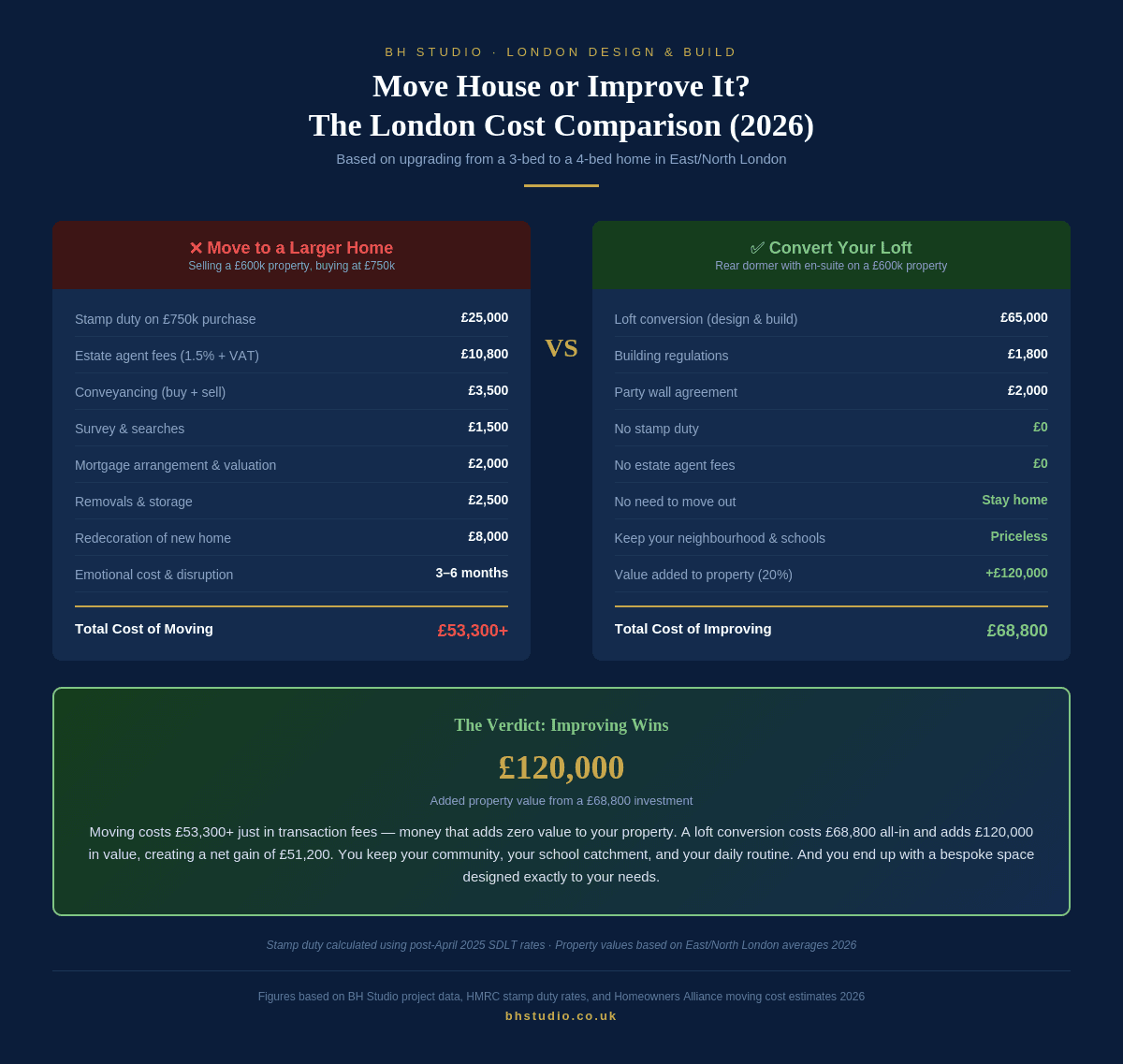
Consider a homeowner in East London with a 3-bedroom Victorian terrace valued at £600,000, looking to gain a fourth bedroom. Moving to a 4-bedroom property in the same area would mean buying at around £750,000. The transaction costs alone are staggering. Under the post-April 2025 stamp duty rates, stamp duty on a £750,000 purchase is approximately £25,000. Estate agent fees on selling the £600,000 property at 1.5% plus VAT come to £10,800. Conveyancing for both transactions runs £3,500. Add survey costs, mortgage fees, removals, storage, and the inevitable redecoration of the new home, and you're looking at £53,000+ before you've added a single pound to your housing wealth.
By contrast, a dormer loft conversion delivering that fourth bedroom and an en-suite costs £65,000–£75,000 all-in - and adds approximately £120,000 to your property's value. You keep your neighbourhood, your school catchment, your commute, and your community. The maths is clear: moving costs more and adds nothing to your equity; improving costs less and builds wealth.
There are legitimate reasons to move - a job relocation, a desire for a completely different neighbourhood, or a property that genuinely cannot accommodate the space you need. But if your motivation is simply "we need another bedroom" or "we need more kitchen space," a loft conversion or extension will almost always be the better financial decision.
When a Loft Conversion Is the Better Choice
A loft conversion is typically the right choice when you need an additional bedroom, a home office, or a self-contained en-suite retreat. It's the superior option when your budget is under £80,000, when you want to preserve your garden, and when minimising disruption is a priority. For Victorian and Edwardian terraced houses - which make up the majority of London's residential stock in Hackney, Islington, Walthamstow, and surrounding areas - a loft conversion is often the single most valuable improvement you can make.
Loft conversions also make sense when you're concerned about planning permission. The fact that most conversions fall under permitted development means you can proceed faster and with more certainty. If you live in a conservation area where rear extensions face scrutiny, a carefully designed loft conversion (particularly a Velux conversion that doesn't alter the external roofline) may be the only option that avoids the planning process entirely.
From a financial perspective, loft conversions deliver the strongest ROI for homeowners who are building equity. If you plan to sell within 5–10 years, the extra bedroom created by a loft conversion is one of the most powerful selling points you can add. Estate agents consistently report that an additional bedroom with an en-suite is the single feature that has the biggest impact on a London property's asking price.
When a House Extension Is the Better Choice
Extensions are the right choice when your primary need is ground-floor living space. If your kitchen is cramped, your dining area is too small for your family, or you dream of an open-plan kitchen-diner with bifold doors opening onto the garden, an extension is the way to achieve it. No loft conversion, however well designed, can solve a ground-floor space problem.
Extensions also make sense when your loft isn't suitable for conversion. If your ridge height is below 2.2m, if the roof structure is complex or damaged, or if previous loft work has already consumed the permitted development volume allowance, an extension may be your only viable option. Properties with flat roofs or very shallow pitches - common in some post-war London homes - are rarely good candidates for loft conversions.
For accessibility needs, extensions are often essential. If a member of your household has mobility challenges, ground-floor space additions ensure that the new rooms are accessible without stairs. This is a consideration that becomes increasingly important for homeowners planning for the long term.
Finally, if your property is detached with a large garden and you have the budget for a wraparound or double-storey extension, the sheer volume of additional space you can create may outweigh the value-per-pound advantage of a loft conversion. A well-designed double-storey extension can add 15–20% to property value while transforming the entire character of the home.
Can You Do Both? The Combined Approach
Increasingly, the answer for London homeowners isn't "loft or extension" - it's "both." Combining a loft conversion with a rear or side return extension in a single project is becoming the most popular approach for families who want to transform their entire home, and the economics strongly support it.
A combined project delivers 20–30% property value uplift - significantly more than either option alone. The cost savings from doing both simultaneously are also substantial: a single scaffold erection serves both the loft and extension work; one party wall agreement covers the whole project; design and structural engineering work is consolidated; and you only live through one period of disruption rather than two.
From a practical standpoint, a combined approach works particularly well for Victorian terraces. A rear dormer or L-shaped loft conversion adds the fourth bedroom with en-suite, while a side return extension opens up the kitchen into a generous open-plan living space. The result is a home that feels completely different - more spacious, more functional, and significantly more valuable - delivered in a single managed project lasting 4–6 months.
This is where the design-and-build model shows its strength. When a single company manages both the loft conversion and the extension, the design is coordinated from the outset - structural loads are calculated holistically, the staircase integration is planned to work with both the new ground-floor layout and the loft space, and the build sequence is optimised to minimise total project time. Architecture-only firms design the plans but hand you over to a builder for construction, creating a coordination gap that often leads to delays and cost overruns. With a design-and-build company, there's a single point of accountability from the first sketch to the final key handover.
How to Choose the Right Company for Your Project
Whether you choose a loft conversion, an extension, or both, the company you work with will have a bigger impact on the outcome than almost any other decision. London's construction market is competitive, and quality varies enormously. Here are the questions that matter most.
At Better Homes, design and build is a managed service: your architect prepares the drawings and agreed submissions, and we carry out the construction. Bring your own architect or choose one we recommend. With either route, you can ask us to coordinate discussions, follow up questions and speak on your behalf with your agreement. You approve the design, budget and changes; the proposal identifies the coordination support, appointments and fees.
Second, check their insurance and guarantees. Any reputable company should carry a minimum of £2 million public liability insurance. A 10-year workmanship guarantee demonstrates confidence in the quality of their work. Ask to see proof - not just a claim on a website. Third, request examples of completed projects in your borough. A company with experience in Hackney's conservation areas or Islington's planning restrictions will navigate the approval process far more efficiently than one working in the area for the first time.
Finally, get a fixed-price contract. Variable-price or cost-plus contracts transfer all financial risk to you. A fixed-price contract with clearly defined specifications protects you from cost creep and ensures the company has done its due diligence during the design phase. Ask about payment milestones - a typical structure ties payments to completed stages of work rather than calendar dates.
Quick Takeaways
- Loft conversions cost 20–35% less per square metre than extensions and deliver higher ROI in most London boroughs
- A dormer loft conversion adds 15–25% to property value; a single-storey extension adds 5–10%. Combined projects deliver 20–30%
- Moving house in London costs £53,000+ in transaction fees that add zero equity - improving almost always wins financially
- Victorian terraces in East and North London are ideal for loft conversions; Edwardian semis suit hip-to-gable conversions
- Most loft conversions qualify for permitted development; extensions are more likely to need planning permission
- Design-and-build companies eliminate the coordination gap between architect and builder, reducing delays and cost overruns
- If you need both more bedrooms and more living space, a combined loft conversion and extension project delivers the best overall value
Frequently Asked Questions
Is a loft conversion or house extension cheaper in London?
A loft conversion is almost always cheaper. A rear dormer costs £45,000–£75,000 in London, while a comparable single-storey rear extension costs £50,000–£85,000. The cost per square metre is also lower for loft conversions (£1,800–£3,200) compared to extensions (£2,500–£3,500) because loft conversions work with existing structural infrastructure rather than building from scratch.
Which adds more value - a loft conversion or extension?
A loft conversion typically adds more value per pound spent. In London, a dormer loft conversion adds 15–25% to property value, while a single-storey extension adds 5–10%. The exception is open-plan kitchen extensions, which can add 10–15%, and double-storey extensions, which can add 15–20%. For maximum value, a combined loft conversion and extension delivers 20–30% uplift.
Do I need planning permission for a loft conversion in London?
Most loft conversions in London qualify for permitted development and don't need planning permission. You'll need planning permission if your property is in a conservation area, is a listed building, is a flat or maisonette, or if the conversion exceeds 40m³ (terraced) or 50m³ (semi-detached/detached) of additional roof volume. Mansard conversions almost always require planning permission.
How long does a loft conversion take compared to an extension?
A loft conversion takes 6–14 weeks on site, with a total project time of 4–7 months. An extension takes 10–24 weeks on site, with a total of 5–10 months. If planning permission is needed for either option, add 8–13 weeks for the application process.
Can I do a loft conversion and extension at the same time?
Yes, and this is increasingly the most popular choice for London homeowners. Doing both as a single project saves money (shared scaffold, one party wall agreement, consolidated design fees), reduces total disruption time, and delivers the highest value uplift at 20–30%. Better Homes can build both elements and, if you wish, coordinate with your own or a recommended architect. Appointments and fees are set out in your proposal.
Is it cheaper to move house or convert my loft in London?
Converting your loft is almost always cheaper. Moving from a £600,000 property to a £750,000 property costs approximately £53,000+ in stamp duty, estate agent fees, conveyancing, and other transaction costs - none of which add to your equity. A loft conversion costs £65,000–£75,000 and adds roughly £120,000 in property value, creating a net financial gain.
What's the difference between a design-and-build company and an architect?
At Better Homes, design and build is a managed service: your architect prepares the drawings and agreed submissions, and we carry out the construction. Bring your own architect or choose one we recommend. With either route, you can ask us to coordinate discussions, follow up questions and speak on your behalf with your agreement. You approve the design, budget and changes; the proposal identifies the coordination support, appointments and fees.
Have a Question About Your Home?
Every London property is different, and the best choice between a loft conversion and extension depends on your specific home, budget, and goals. If you've found this guide helpful, we'd love to hear from you. What type of property do you have, and what's holding you back from making a decision? Drop us a message or share this guide with someone who's facing the same choice. And if you'd like personalised advice based on a free assessment of your home, get in touch with Better Homes - we'll help you understand exactly what's possible and what it will cost, with no obligation.
Conclusion - Making the Right Decision for Your London Home
The choice between a loft conversion and a house extension isn't one-size-fits-all, but for the majority of London homeowners - particularly those with Victorian terraces or Edwardian semi-detached homes - a loft conversion delivers better value, less disruption, and a faster result. The numbers bear this out: lower cost per square metre, higher percentage value uplift, faster build times, and a greater likelihood of qualifying for permitted development.
That said, extensions have an important role. If ground-floor living space is your priority - a bigger kitchen, an open-plan family area, or accessible rooms on one level - an extension is the right tool for the job. And for homeowners who can afford it, the combined approach of loft conversion plus extension delivers the greatest transformation and the strongest financial return.
Whatever you choose, the single most important decision is who you work with. A design-and-build company with genuine London experience - one that understands your borough's planning quirks, your property type's structural opportunities, and the logistics of building in a dense urban environment - will deliver a fundamentally better outcome than trying to coordinate separate architects and builders yourself.
Bring your architect or choose an independent architect we recommend. We manage construction, with agreed coordination support. Our workmanship guarantee covers structural work, extensions and loft conversions for 10 years, bathroom and kitchen installations for 2 years, and decoration for 1 year. Item breakages are excluded from our workmanship guarantee and fall under the manufacturers’ own guarantees. Insurance cover up to £10 million. Ask for current certificates and the cover applicable to your project.
References
- Planning Portal - Loft Conversion Planning Permission (2026)
- GOV.UK - Permitted Development Rights for Householders: Technical Guidance
- MoneyHelper - Stamp Duty Calculator 2026 (SDLT Rates)
- HomeOwners Alliance - Cost of Moving House Calculator 2026
- Which? - Loft Conversion Planning Permission and Building Regulations (2026)